
Stock Splits and Bonus Issues: How They Affect Your Holdings
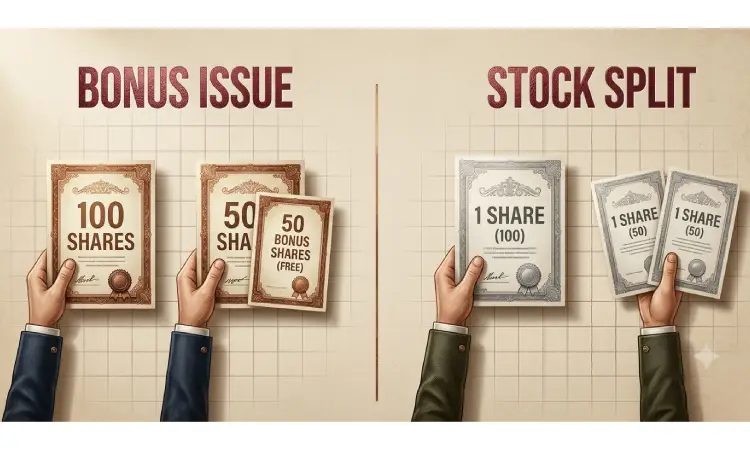
You wake up, open your app, and your holding has doubled. 100 shares became 200. Free shares. From the company. For nothing.
You made exactly ₹0.
Because the price halved at the same moment. Same money, more pieces. It’s a pizza cut into eight slices instead of four — you are not holding more pizza.
This is the single most misunderstood category of event in the market. People celebrate splits and bonuses as windfalls. They aren’t. They are accounting events, not value events. And in one specific case, the “free” shares can hand you a tax bill you’d never have had otherwise.
Here’s what’s actually happening.
The idea underneath both
A company’s market capitalisation is shares × price. That’s it.
Splits and bonuses both increase the share count. So the price must fall proportionally, or the company would have magically become worth more overnight because of a press release. Markets don’t work that way.
| Before | After a 1:1 bonus |
|---|---|
| 100 shares × ₹1,000 = ₹1,00,000 | 200 shares × ₹500 = ₹1,00,000 |
Your wealth: unchanged. Your ownership percentage of the company: unchanged. Everyone got the same treatment at the same time, so nobody’s slice grew relative to anyone else’s.
So why do two different mechanisms exist for the same non-event? Because they’re built differently — and the difference matters enormously, mostly at tax time.
Stock splits: cutting the face value
Every share has a face value (or par value) — a nominal figure fixed in the company’s records. ₹10, ₹5, ₹2, ₹1. It has nothing to do with market price. A share with ₹10 face value can trade at ₹4,000.
A stock split works by cutting the face value. That’s the whole mechanism. Everything else follows automatically.
Split a ₹10 face value into ₹1, and each old share must become ten new ones — because the total face value of your holding can’t change.
Worked example
You hold 100 shares, face value ₹10, trading at ₹2,000. Value: ₹2,00,000.
The company splits ₹10 → ₹1.
| Before | After | |
|---|---|---|
| Face value | ₹10 | ₹1 |
| Shares held | 100 | 1,000 |
| Market price | ₹2,000 | ₹200 |
| Your value | ₹2,00,000 | ₹2,00,000 |
Ten times the shares, one-tenth the price, identical wealth.
What happens on the company’s books
Almost nothing. Paid-up share capital is unchanged. Reserves are unchanged. No money moves anywhere. The company has simply re-denominated its own equity — like changing a ₹2,000 note for ten ₹200 notes.
Why bother?
Liquidity and accessibility. A ₹15,000 share prices out small investors and widens the bid-ask spread. At ₹1,500 the same company is easier to trade in sensible quantities. If you’ve read our piece on how stock prices are determined, you’ll recognise why that matters — a stock with more participants has tighter spreads and a deeper order book, and both are real costs to you.
Bonus issues: capitalising the reserves
A bonus issue looks similar from your app. Underneath, it’s a completely different transaction.
The face value does not change. Instead, the company issues genuinely new shares — and it has to pay for them.
Not with cash. With reserves.
Over years, a profitable company accumulates retained earnings and free reserves. These already belong to shareholders; they’re just sitting on the balance sheet. In a bonus issue, the company moves an amount out of those reserves and into paid-up share capital, and issues new shares against it.
Reserves down. Share capital up. Total shareholders’ equity: unchanged.
That’s why it’s called capitalising reserves. It’s a shuffle between two pockets of the same trouser. Nothing entered the company and nothing left.
This is exactly the sort of thing you learn to read straight off a balance sheet — and if you can see a bonus issue in the reserves line, you can see a great deal else besides. It’s the core skill our fundamental analysis course is built around.
Reading the ratio (get this right)
In India, a bonus is quoted as X:Y — X new shares for every Y you already hold.
| Ratio | Meaning | 100 shares becomes |
|---|---|---|
| 1:1 | 1 free share for every 1 held | 200 |
| 1:2 | 1 free share for every 2 held | 150 |
| 2:1 | 2 free shares for every 1 held | 300 |
A 1:1 bonus doubles your count — it doesn’t leave it unchanged. People misread this constantly.
Why bother?
- Signalling. A bonus says we have real accumulated reserves and we’re confident enough to lock them into capital permanently. Reserves can be paid out later; capitalised reserves largely can’t. That’s a genuine commitment.
- Rewarding shareholders without spending cash. Unlike a dividend, no money leaves the business.
- Liquidity, same as a split.
Split vs bonus: side by side
| Stock Split | Bonus Issue | |
|---|---|---|
| Face value | Reduced | Unchanged |
| New shares issued? | No — existing ones subdivided | Yes — genuinely new shares |
| Source | Nothing. Re-denomination | Free reserves / retained earnings |
| Reserves | Unchanged | Reduced |
| Paid-up capital | Unchanged | Increased |
| Your wealth | Unchanged | Unchanged |
| Cost of acquisition | Apportioned | NIL on the new shares |
| Holding period | Preserved | Restarts on the new shares |
Those last two rows are where the money is. Hold that thought.
The dates that decide whether you get anything
Record date — the day the company checks its register. Whoever’s on it gets the entitlement.
Ex-date — from this day, the stock trades without the entitlement, and the price adjusts.
The trap: buying on the ex-date is too late. India settles at T+1, so shares bought on day T reach your demat on T+1. To be on the register for the record date, you must have bought before the ex-date. Buy on the day and you’ve bought the adjusted price with none of the entitlement.
And for bonus issues specifically, this got much faster. SEBI’s framework — mandatory for bonus issues announced on or after 1 October 2024 — requires bonus shares to be credited and available for trading on T+2, where T is the record date.
| Day | What happens |
|---|---|
| T | Record date |
| T+1 | Deemed date of allotment; issuer submits documents to depositories |
| T+2 | Bonus shares tradable |
Before this, credit could take anywhere from two to seven working days, often via a temporary ISIN. SEBI scrapped the temporary ISIN — bonus shares now credit straight into the company’s existing permanent ISIN.
Why you should care: in that old gap, your holding showed a halved price while the bonus shares hadn’t arrived. Every year, investors saw a 50% drop, panicked, and sold at the bottom of their own misunderstanding. The T+2 rule closes most of that window. It doesn’t close the panic — knowing what’s happening does.
The tax trap nobody warns you about
Here’s the part worth the whole article.
A split is tax-neutral
- Cost of acquisition: apportioned across the new share count
- Date of acquisition: unchanged — your original purchase date carries over to every split share
Bought at ₹1,00,000 in January 2024, then a 1:10 split? You now hold 1,000 shares at ₹100 cost each, all still deemed acquired in January 2024. Nothing has been done to you.
A bonus is not
Under the Income Tax Act:
- Cost of acquisition of bonus shares = NIL (Section 55(2)(aa), for bonus allotted on or after 1 April 2001)
- Holding period runs from the date of allotment of the bonus shares — not from when you bought the originals
Receiving them isn’t taxable. Selling them very much is — and with a zero cost base, the entire sale price is a capital gain.
What this actually costs — worked
You buy 100 shares at ₹400 in January 2024. Cost: ₹40,000.
By January 2026 the stock is ₹1,000. You’ve held two years. Your holding is worth ₹1,00,000.
The company declares a 1:1 bonus, record date February 2026. You get 100 bonus shares; the price adjusts to ₹500. You still have ₹1,00,000. Nothing gained.
In March 2026 you sell all 200 shares at ₹500 = ₹1,00,000.
Scenario A — no bonus had happened. You’d sell 100 shares at ₹1,000 = ₹1,00,000. Gain ₹60,000. Held 2 years → LTCG. Below the ₹1.25 lakh annual exemption → tax: ₹0.
Scenario B — with the bonus:
| Original 100 | Bonus 100 | |
|---|---|---|
| Sale value | ₹50,000 | ₹50,000 |
| Cost | ₹40,000 | NIL |
| Gain | ₹10,000 | ₹50,000 |
| Held since | Jan 2024 (2 yrs) | Feb 2026 (1 month) |
| Classification | LTCG | STCG |
| Tax | ₹0 (under exemption) | ₹50,000 × 20% = ₹10,000 |
Plus 4% cess: ₹10,400.
Identical economics. Identical sale proceeds. ₹0 versus ₹10,400.
The “free” shares cost you ten thousand rupees — and only because of when you sold them.
The fix is boring and free
Hold the bonus shares for more than 12 months from allotment, and they become long-term too. The trap only springs if you sell soon after.
Also worth knowing:
- FIFO applies. Sell part of a demat holding and the earliest-acquired shares are deemed sold first — which, helpfully, is usually your original long-term lot.
- Bonus stripping (Section 94(8)) exists to stop people engineering artificial losses around bonus record dates. If you’re contemplating anything clever here, talk to a CA first — not a blog.
Current rates for listed equity (transfers on or after 23 July 2024): STCG 20% under Section 111A; LTCG 12.5% above a ₹1.25 lakh annual exemption under Section 112A, no indexation, plus cess. Note the STCG rate went up from 15% — a great deal of the internet hasn’t caught up.
So does the price actually rise?
Often, prices do move up around these announcements. Two honest reasons and one dishonest one:
Signalling. Boards rarely declare bonuses when they’re worried. It carries information about confidence — and information is legitimately priced.
Liquidity. A more accessible price genuinely can attract more participants and tighten spreads.
And the dishonest one: a lot of buying is people who think ₹500 is “cheaper” than ₹1,000. It isn’t. It’s the same company at the same valuation with twice as many slices. That demand is real, and it is built on a misunderstanding.
Which is precisely why understanding this puts you ahead of most of the market — not because you can trade it, but because you won’t be the person on the wrong side of it.
FAQs
Do I make money from a stock split or bonus issue? No. Your share count rises and the price falls proportionally. Your total value and your ownership percentage are unchanged on the day.
What’s the difference between a stock split and a bonus issue? A split reduces the face value and subdivides existing shares — nothing moves on the balance sheet. A bonus keeps the face value and issues genuinely new shares funded by transferring free reserves into share capital.
Are bonus shares taxable when I receive them? No. There’s no tax on receipt. Tax applies when you sell — and because bonus shares have a nil cost of acquisition, the entire sale value is treated as capital gain.
Why did my bonus shares get taxed as short-term when I’ve held the stock for years? Because the holding period for bonus shares runs from their allotment date, not your original purchase date. Sell within 12 months of allotment and they’re short-term, however long you’ve owned the originals.
When do bonus shares reach my demat account? Under SEBI’s framework for issues announced on or after 1 October 2024, they’re credited and tradable on T+2, where T is the record date.
If I buy on the record date, do I get the bonus? No. India settles at T+1, so you must buy before the ex-date to be on the register. Buying on the ex-date gets you the adjusted price without the entitlement.
Does a 1:1 bonus double my shares? Yes. In India the ratio means X new shares for every Y held, so 1:1 gives you one extra share per share owned — doubling your count and roughly halving the price.
Read the company, not the headline
A bonus issue is a line moving between two rows of a balance sheet. Once you can read that, “the company gave us free shares!” stops being news and starts being information.
That’s the whole point of fundamental analysis — reading what a company is actually doing, from its own statements, instead of from a WhatsApp forward.
Dadar (Head Office): +91 99304 40999 | Thane: +91 99874 98599 Mon–Sat, 9 AM – 9 PM (Sunday by appointment)
Explore our courses · Admission process · Book free counselling