
Market Capitalisation Explained: Large-Cap, Mid-Cap and Small-Cap
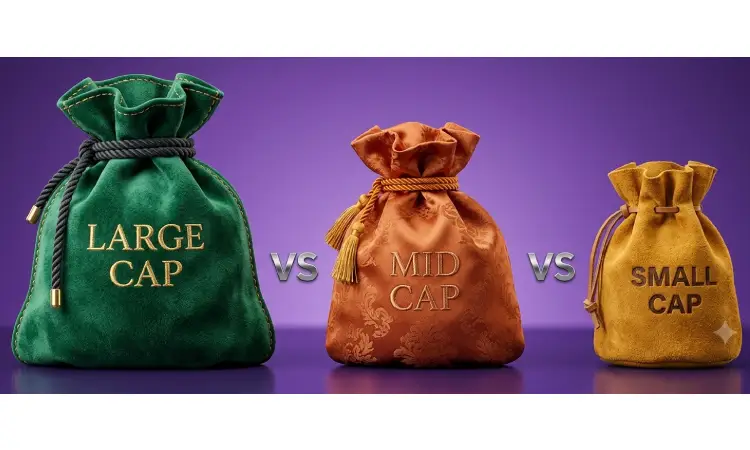
In January 2026, Bosch was promoted from mid-cap to large-cap.
Six months later, in July 2026, it was demoted back to mid-cap. So was Hero MotoCorp — same round trip, same six months.
Did Bosch shrink? Did it become a worse company, then a better one, then a worse one again? No. Nothing about the business changed at all.
It just got out-run. And that one fact tells you almost everything you need to know about how these labels actually work — because most people have the whole thing backwards.
The formula
Start with the easy part.
Market Capitalisation = Total Shares Outstanding × Current Market Price
A company with 10 crore shares trading at ₹500 has a market cap of ₹5,000 crore. That’s the market’s collective verdict on what the whole company’s equity is worth, right now.
That’s it. There’s no committee, no formula more complex than multiplication.
What market cap is NOT
It is not the price of the company. This trips up almost everyone.
If a company has a market cap of ₹5,000 crore, you cannot buy it for ₹5,000 crore. You’d also inherit its debt. The figure that reflects that is Enterprise Value:
Enterprise Value = Market Cap + Debt − Cash
Two companies can both be worth ₹5,000 crore in market cap while one sits on ₹2,000 crore of cash and the other carries ₹3,000 crore of debt. In any real sense, those are not the same size at all. Market cap sees only the equity. It is deliberately blind to the balance sheet.
It is not “the share price.” A ₹50 share can belong to a far bigger company than a ₹5,000 share. Price alone tells you nothing about size — only price × count does. Which is exactly why a stock split changes the price dramatically and the market cap not at all.
Full vs free-float — the distinction that catches people out
Not all shares are actually available to trade. Promoters, the government and strategic holders sit on large blocks that never move.
- Full market cap — every share, regardless of who holds it
- Free-float market cap — only the shares genuinely available to the public
Both are used in India, for different purposes:
| Used for | Which one |
|---|---|
| SEBI/AMFI large/mid/small classification | Full market cap |
| Nifty 50, Sensex index weights | Free-float market cap |
So a company with heavy promoter or government holding can rank high on full market cap while carrying modest index weight. Both figures are correct. They’re measuring different things, and if you quote one where the other belongs, your numbers won’t reconcile.
How SEBI actually classifies stocks
Here’s the part most articles get wrong.
Search “large cap definition” and you’ll get a rupee figure — “companies above ₹1 lakh crore.” That is not the definition. It’s a by-product of it.
SEBI’s circular of 6 October 2017 defines the categories purely by rank:
| Category | Definition |
|---|---|
| Large Cap | Companies ranked 1st to 100th by full market capitalisation |
| Mid Cap | Companies ranked 101st to 250th |
| Small Cap | Companies ranked 251st onwards |
That’s the whole rule. Not a rupee in sight.
AMFI publishes the list, using average full market cap over the preceding six months, and it’s revised twice a year. The rupee “cutoff” everyone quotes is simply whatever the 100th company happened to be worth in that window.
Watch it move
| List | Large-cap cutoff | Mid-cap cutoff |
|---|---|---|
| July 2025 | ~₹91,500 crore | ~₹30,700 crore |
| January 2026 | ~₹1,05,000 crore | ~₹34,700 crore |
| July 2026 (effective 1 Aug 2026) | ~₹1,06,300 crore | ~₹33,500 crore |
The large-cap bar rose by roughly ₹15,000 crore in twelve months. SEBI didn’t change anything. The 100th-ranked company simply got more valuable.
This is why the labels are relative, not absolute. A perfectly healthy company that grows 10% while its peers grow 30% will be demoted — having lost nothing. That’s Bosch. That’s Hero MotoCorp. Neither did anything wrong; the queue moved faster than they did.
Understand this and you’ll stop reading “downgraded to mid-cap” as a verdict on the business. Often it isn’t one.
One more thing: “micro-cap” isn’t a SEBI category
SEBI recognises three. Micro-cap is market shorthand for the far end of the small-cap tail — real as a concept, informal as a label. Indices exist for it; a regulation defining it doesn’t.
The scale gap is enormous
Numbers make this concrete. From AMFI’s July 2026 categorisation, the average market cap in each bucket:
| Category | Average market cap |
|---|---|
| Large cap | ₹2,75,198 crore |
| Mid cap | ₹62,454 crore |
| Small cap | ₹1,806 crore |
Read that again. The average large-cap is roughly 152 times the average small-cap.
These aren’t three flavours of the same thing. They’re different asset classes wearing the same word.
Risk and return by cap: what actually differs
| Large Cap | Mid Cap | Small Cap | |
|---|---|---|---|
| Volatility | Lower | Higher | Highest |
| Liquidity | Deep | Moderate | Often thin |
| Analyst coverage | Heavy | Patchy | Sparse to none |
| Information available | Abundant | Adequate | Limited |
| Growth runway | Slower | Moderate | Potentially high |
| Failure risk | Low | Moderate | Real |
The standard story is “small caps are riskier but grow faster.” True enough, and incomplete. Two risks matter more than volatility, and neither shows up on a chart.
Liquidity risk — the one that actually hurts
A large-cap has thousands of participants and a deep order book. Your order barely registers.
A small-cap may have a handful of shares at each price level. Your order is the market. As we covered in how stock prices are determined, that means wide spreads and severe slippage — and it means the “10% gain” on your screen may be substantially fictional, because realising it requires someone to be there when you sell.
Getting in feels effortless. Getting out — on a red day, when the bids have simply evaporated — is a different experience entirely.
This isn’t theoretical. SEBI has required mutual funds to disclose stress test results for small and mid-cap schemes precisely because the regulator wanted investors to see how long it would take a fund to liquidate a portion of its portfolio in a downturn. When the regulator is publishing exit-time estimates, it’s telling you something.
Information asymmetry
Twenty analysts cover a large-cap. Nobody covers a small-cap. That cuts both ways: mispricing is likelier, which is the whole opportunity — but you have to do the work yourself, from primary documents, with no one to check your reasoning.
Small-cap investing without the ability to read a balance sheet isn’t investing. It’s a hopeful transaction.
Why reclassification actually moves money
Labels would be trivia if they didn’t have teeth. They do.
SEBI’s categorisation rules bind mutual funds to their names:
- A large-cap fund must hold at least 80% in large caps
- A mid-cap fund must hold at least 65% in mid caps
- A small-cap fund must hold at least 65% in small caps
So when AMFI reclassifies, funds don’t get an opinion. A stock promoted from mid to large must be bought by large-cap funds and must be sold by mid-cap funds — regardless of what any manager thinks of it.
That’s why the twice-yearly list gets so much coverage. It’s not a naming ceremony. It’s a scheduled, mandatory reshuffling of real money.
Four mistakes worth not making
“Low share price means small cap.” No relationship whatsoever. Price × count is the only thing that matters.
“Large cap means safe.” It means large. Large companies have destroyed shareholder capital many times over. Size buys you liquidity and scrutiny, not immunity.
“Small cap means high return.” It means high dispersion. Some small caps become mid caps; plenty go to zero. The category average conceals both.
“Cutoffs are fixed.” They move every six months and they’ve risen sharply. Any article quoting a threshold without a date on it is quoting a photograph and calling it a rule.
FAQs
What is market capitalisation in simple terms? Total shares outstanding multiplied by the current share price. It’s the market’s valuation of a company’s entire equity at this moment.
How does SEBI define large, mid and small cap? By rank, not by rupees. The top 100 companies by full market capitalisation are large cap, 101st to 250th are mid cap, and 251st onwards are small cap. AMFI publishes the list twice a year.
What is the current large-cap cutoff in India? Roughly ₹1.06 lakh crore in AMFI’s July 2026 list, with the mid-cap cutoff around ₹33,500 crore. But this isn’t a rule — it’s simply what the 100th and 250th companies were worth in that six-month window. It changes every list.
Is market cap the same as company value? No. Market cap covers equity only. Enterprise Value — market cap plus debt minus cash — is closer to what buying the whole business would cost.
Can a good company be downgraded to mid cap? Easily. Classification is relative. A company that grows steadily while peers grow faster will slip in rank without losing a rupee of value. It happens on almost every list.
Are small-cap stocks riskier? Generally yes — but the bigger risks are liquidity and information, not just volatility. Thin order books mean wide spreads and hard exits, and sparse analyst coverage means you’re on your own for research.
Learn to read the company, not the label
“Large cap” is a rank in a spreadsheet, refreshed twice a year. It tells you where a company sits in a queue. It tells you nothing about whether the business is any good, or whether the price is sane.
That judgement is a skill, and it’s learnable. Our share market classes in Mumbai are built to teach exactly that — from the ground up, in a classroom, with someone who’ll tell you when your reasoning is wrong.
Dadar (Head Office): +91 99304 40999 | Thane: +91 99874 98599 Mon–Sat, 9 AM – 9 PM (Sunday by appointment)
Explore our courses · Admission process · Book free counselling