
IPO Basics: How to Apply, Allotment, and Listing Day Explained
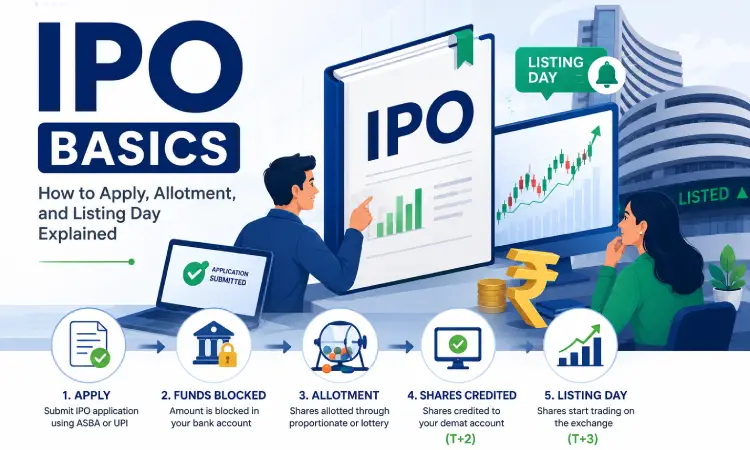
IPO Basics: How to Apply, Allotment, and Listing Day Explained
Everyone Talks About IPOs. Almost Nobody Explains Them Properly
You’ve seen the headlines — a company “oversubscribed 40 times,” another one “lists at a 60% premium.” It sounds exciting, and it makes IPO investing look like something you should be doing too.
Then you actually try to apply, and you hit a wall of unfamiliar terms — ASBA, UPI mandate, cut-off price, lot size, allotment. Nobody explains what any of it means before assuming you’ll figure it out. So here’s the whole process, start to finish, in plain language.
What an IPO Actually Is
An IPO (Initial Public Offering) is the first time a private company sells its shares to the public, listing on the stock exchange in the process. Before this, the company’s shares were held privately — by founders, early investors, or institutions. An IPO opens that ownership up to everyday investors like you, in exchange for the company raising capital.
When you “apply for an IPO,” you’re placing a bid to be allotted a certain number of shares at a price within the company’s announced price band.
What You Need Before You Apply
Two things, non-negotiable:
- A demat account. IPO shares are credited electronically, not as physical certificates, so you can’t receive an allotment without one.
- A PAN-linked bank account with either UPI or ASBA-enabled net banking, since your bid amount gets blocked (not deducted) from this account.
If you already have a trading and demat account with any broker, you’re set. If not, that’s step zero before anything else.
The Two Ways to Apply: ASBA and UPI
Both routes work the same way underneath — your money gets blocked, not withdrawn, until allotment is decided. The difference is just how you authorize that block.
ASBA (Application Supported by Blocked Amount)
ASBA has been mandatory infrastructure for public issues since 2016. You apply through your bank’s net banking portal or an approved intermediary, entering your PAN, demat details, bid quantity, and price. The bank simply places a lien on the required amount in your account — it stays yours, earns interest as usual, and only gets debited if you’re actually allotted shares.
UPI Mandate (the route most retail investors use today)
This is the faster, more common path for retail applications:
- Apply through your broker’s app or platform, selecting the IPO and entering your lot size, bid price, and UPI ID.
- A mandate request lands in your UPI app (Google Pay, PhonePe, or similar).
- You approve it using your UPI PIN — this blocks the required funds in your bank account, same as ASBA.
- If allotted, the amount is debited and shares move to your demat account. If not, the block is simply released.
Retail investors can apply via UPI for amounts up to ₹5,00,000 per transaction under current SEBI-aligned limits.
Three Rules That Trip Up First-Time Applicants
These aren’t optional details — miss them, and your entire application gets rejected:
- The 5 PM deadline. Your UPI mandate must be approved by 5:00 PM on the IPO’s closing day. A mandate approved even a minute late results in a failed application — no exceptions.
- One PAN, one application. You can only submit one application per PAN for a given IPO. Applying through multiple brokers with the same PAN gets every single one of those bids rejected, not just the extras.
- Your own UPI ID only. Never use someone else’s UPI ID or bank account to apply, even a spouse’s or family member’s. The bank account’s PAN must exactly match the applicant’s PAN, or the application becomes ineligible.
How Allotment Actually Works
Once the IPO closes, the registrar tallies every valid application and finalizes who gets shares — and this is where most of the disappointment (or excitement) lives.
- If the issue is undersubscribed (fewer bids than shares available), allotment is typically proportional — everyone who applied gets shares, roughly matching what they bid for.
- If the issue is oversubscribed (more common for hyped IPOs), retail allotment usually runs through a lottery-style system — being a valid applicant doesn’t guarantee you shares, it just gets you into the draw.
- Investor categories matter. Retail Individual Investors (applications up to ₹2 lakh), Non-Institutional Investors, and Qualified Institutional Buyers each have separate reserved portions of the total issue, so retail investors aren’t competing against large institutional bids for the same pool of shares.
If you don’t get allotted, the blocked amount is simply released back to you — no refund process to chase, since the money was never actually debited in the first place.
The Timeline: From Bid to Listing Day
A typical IPO timeline runs like this once the issue closes:
- T+1 (one working day after closing): Allotment status is finalized by the registrar.
- T+2: If you’re allotted shares, they’re credited to your demat account.
- T+3: The company lists and begins trading on the exchange — this is listing day, when the market decides what the stock is actually worth versus what you paid.
If you weren’t allotted, your blocked funds are released around the same time, well before listing day.
Before You Bid: What Actually Matters
Excitement around an IPO — the oversubscription numbers, the grey market premium chatter — isn’t the same as understanding what you’re buying into. Before placing any bid:
- Read the RHP (Red Herring Prospectus). This is the company’s own disclosure document — financials, risks, how the money raised will actually be used. It’s dense, but it’s the one document written specifically to inform your decision.
- Treat grey market premium as sentiment, not signal. It reflects unofficial pre-listing demand, not a guaranteed listing price. Plenty of high-GMP IPOs have listed flat or lower.
- Only commit money you’re fine having blocked for several days. Even though it’s not gone, it’s not usable elsewhere until allotment is resolved.
- A strong listing pop doesn’t mean a strong company. Some of the most hyped listings have underperformed for years afterward. The listing day and the long-term investment case are two different questions entirely.
The Real Takeaway
Applying for an IPO isn’t complicated once you know the mechanics — it’s a handful of steps, a couple of strict deadlines, and a process where your money is protected (blocked, not spent) throughout. The part that actually deserves your attention isn’t the application form. It’s whether the company behind the IPO is actually worth owning once the listing-day noise settles down.
That judgment — reading a prospectus properly, separating hype from fundamentals, understanding valuation — is exactly what structured learning builds over time, rather than something you pick up from a headline about oversubscription numbers. If you want to build that skill properly, Upside’s Fundamental Analysis course covers exactly how to evaluate a company’s financials and worth before you commit your money to it — IPO or otherwise.
Frequently Asked Questions
Do I need a demat account to apply for an IPO? Yes. IPO shares are credited electronically, so a valid demat account is mandatory for both applying and receiving allotment.
What’s the difference between ASBA and UPI for IPO applications? Both block your funds rather than debiting them immediately. ASBA works through your bank’s net banking portal directly; UPI works through a mandate request you approve in apps like Google Pay or PhonePe, usually via your broker’s platform.
What happens if I don’t get allotted shares? The blocked amount is simply released back into your bank account. Since the money was never actually debited, there’s no separate refund process to wait for.
Can I apply for the same IPO from two different brokers? No. Using the same PAN across multiple applications for one IPO results in all of those applications being rejected, not just the additional ones.
How is allotment decided if an IPO is oversubscribed? For retail investors, oversubscribed issues are typically allotted through a lottery-style system, meaning a valid application improves your odds but doesn’t guarantee shares.
When do allotted shares actually start trading? Following the IPO’s closing date, allotment is finalized on T+1, shares are credited to your demat account on T+2, and the stock begins trading on the exchange on T+3, known as listing day.
Still have questions? Ask your AI
Get instant answers about IPO applications, allotment and listing day — straight from the AI assistant you already use.
 ChatGPT
 Claude
 Gemini
 Perplexity
 Grok
Grok