
Global Cues & Nifty: How US Fed Rates, the Dollar Index and Crude Oil Move Indian Markets
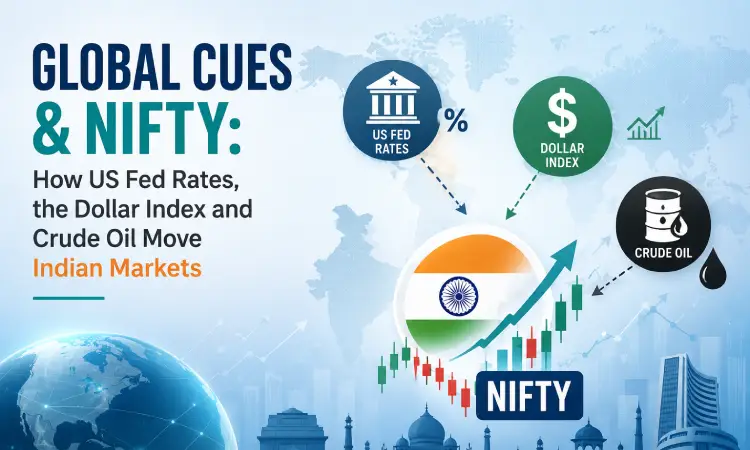
Open any market news channel before the Indian markets open, and you’ll hear the same phrase within the first minute: “following weak global cues.” Most beginners nod along without really knowing what that means. Here’s what’s actually happening when a Fed announcement in Washington moves your portfolio in Mumbai the next morning.
Why Indian Markets React to What Happens Abroad
The Nifty and Sensex don’t move in isolation. Foreign Portfolio Investors (FPIs) hold a significant share of Indian equities, global commodity prices affect Indian companies directly, and the rupee’s value against the dollar influences everything from import costs to corporate earnings. When a major global event shifts any of these, Indian markets feel it — sometimes before the local market even fully understands why.
Three global factors matter more than almost anything else for a trader or investor tracking Indian markets: US Federal Reserve interest rate decisions, the US Dollar Index, and crude oil prices.
US Fed Rate Decisions
Why It Matters to India
When the US Federal Reserve raises interest rates, US government bonds and fixed-income instruments become more attractive relative to riskier assets like emerging market equities. This often triggers FPI outflows from Indian markets, as global investors shift capital toward safer, higher-yielding US assets.
The reverse is also true — when the Fed signals rate cuts or holds rates steady in a way markets read as dovish, capital tends to flow back into emerging markets like India, often pushing indices higher.
What to Watch
- FOMC (Federal Open Market Committee) meeting dates and statements, not just the rate decision itself — the language around future policy often moves markets more than the rate change
- FPI flow data, published regularly, which shows whether foreign investors are net buyers or sellers of Indian equities
- How rate-sensitive sectors in India — banking, real estate, auto — react disproportionately compared to the broader index
The US Dollar Index (DXY)
The Direct Link to the Rupee
The Dollar Index tracks the US dollar’s strength against a basket of major currencies. A strong dollar typically means a weaker rupee, since capital gets pulled toward dollar-denominated assets. A weaker rupee has real consequences for Indian companies:
- Importers (oil, electronics, certain raw materials) face higher costs, squeezing margins
- Exporters (IT services, pharmaceuticals) often benefit, since their dollar revenue converts to more rupees
- Inflation can tick up when the rupee weakens, since imported goods and commodities become more expensive
This is why IT and pharma stocks often behave differently from banking and auto stocks during periods of dollar strength — the same macro event affects sectors in opposite directions.
Crude Oil Prices
India’s Structural Vulnerability
India imports the large majority of its crude oil needs, which makes the country’s markets and currency unusually sensitive to oil price swings compared to oil-producing economies. When crude oil prices rise sharply:
- India’s import bill grows, widening the current account deficit
- The rupee often weakens further as more dollars are needed to pay for oil
- Inflation pressure builds, which can influence RBI policy decisions
- Oil marketing companies and aviation stocks face direct margin pressure
We’ve covered the specific mechanics of what drives crude oil prices — supply decisions, geopolitical events, demand shifts — in more depth in our earlier post, Crude Oil Trading: Factors That Drive Prices, which is worth reading alongside this one if you’re trying to connect global commodity moves to Nifty behaviour.
Putting the Three Together
These factors rarely move in isolation — they interact. A hawkish Fed decision can strengthen the dollar, which can pressure the rupee, which combined with rising crude oil can create a compounding headwind for Indian markets all at once. Traders who only watch domestic news often get blindsided by moves that were visible in global data the night before.
This is exactly the kind of context-reading skill that separates a trader reacting to price movement from one who understands why the movement is happening — and it’s a core part of what’s taught in Upside’s Research Analysis certification course, which covers how to read past and present market data, including global macro context, to make more informed decisions. Pairing that understanding with Fundamental Analysis gives you the full picture of how global events filter down into individual company performance.
Frequently Asked Questions
Why do Indian stock markets fall when the US Fed raises interest rates? +
Higher US rates make dollar-denominated assets more attractive to global investors, often triggering Foreign Portfolio Investor outflows from emerging markets like India, which puts downward pressure on Indian indices.
How does the US Dollar Index affect Indian stocks? +
A stronger dollar typically weakens the rupee, which raises costs for import-dependent sectors while benefiting export-driven sectors like IT and pharma, causing different parts of the market to react in opposite directions.
Why is India’s market so sensitive to crude oil prices? +
India imports most of its crude oil needs, so rising oil prices increase the import bill, weaken the rupee, and add inflationary pressure — all of which affect market sentiment and specific sectors like aviation and oil marketing companies.
Do global cues affect all sectors of the Indian market equally? +
No. Rate-sensitive sectors like banking and real estate, and currency-sensitive sectors like IT and pharma, often respond quite differently to the same global event.
Where can I learn to read global market context alongside company analysis? +
Upside’s Research Analysis and Fundamental Analysis courses cover how macro factors like global rates and commodity prices connect to individual stock and sector performance.
Read the Market, Not Just the Chart
Understanding why Indian markets move the way they do means looking beyond domestic headlines. Explore Upside’s Research Analysis course to build that broader market context, or talk to our team about where to start.