AI and Stock Screeners: Should You Trust Algorithmic Stock Picks in 2026?
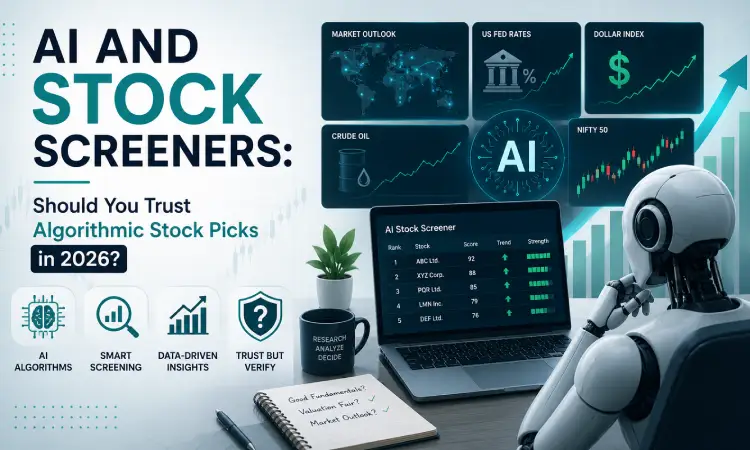
An AI tool scans thousands of stocks in seconds and hands you a neat list of “top picks” with confidence scores attached. It feels like having a research team in your pocket. But a confidence score isn’t the same as being right — and 2026 is full of traders learning that difference the expensive way.
Why AI Stock Screeners Are Suddenly Everywhere
Screening tools built on machine learning have become genuinely accessible over the past couple of years — no longer limited to hedge funds with data science teams. Today’s retail-facing platforms can scan valuation ratios, price momentum, earnings surprises, and even news sentiment across the entire market in a fraction of the time it would take a human analyst.
That’s a real advantage. The question isn’t whether AI screening is useful — it clearly speeds up the process of narrowing thousands of stocks down to a shortlist. The question is whether you should trust its output as a final answer, or treat it as a starting point.
What AI Screeners Are Actually Good At
- Speed and scale. Scanning the entire market for stocks matching specific criteria — say, low P/E with rising revenue — is something no human can do manually across thousands of listings.
- Pattern detection across large datasets. Some tools identify statistical patterns in price behaviour or fundamentals that would be genuinely hard to spot by eye.
- Removing initial bias. A screener doesn’t have a favourite stock going in — it filters based on the criteria you set, which can surface names you’d never have considered.
Where AI Screening Falls Short
It Doesn’t Understand Context, Only Data
An AI model can flag a stock as “undervalued” based on historical ratios without understanding why it’s cheap — a genuine turnaround opportunity looks statistically identical to a company in real structural decline until you dig into the actual business.
It’s Trained on the Past, Not the Future
Machine learning models are built on historical data. They’re excellent at recognising patterns that have repeated before, and far weaker at anticipating genuinely new situations — a regulatory shift, a management change, or a one-off event that doesn’t resemble anything in the training data.
“Confidence Scores” Can Be Misleading
A high confidence score reflects how strongly a pattern matches the model’s training data, not how certain the outcome actually is. Treating a 90% confidence score the way you’d treat a guarantee is one of the most common — and costly — mistakes new users of these tools make.
It Can’t Read Trading Psychology or Position Sizing
Even a technically accurate stock pick can lose money if it’s sized incorrectly, entered emotionally, or held without a plan. AI screeners suggest what, not how much or when to exit — the exact skills covered in trading psychology and risk management.
How to Actually Use These Tools Well
- Treat screener output as a shortlist, not a final decision. Use it to narrow thousands of stocks down to a manageable few worth researching properly.
- Verify with fundamental analysis. Read the actual financial statements behind any name the screener surfaces — the tool can’t tell you if a company’s growth is sustainable or one-off.
- Check the technical picture separately. A fundamentally sound pick can still be technically weak in the short term — timing still matters.
- Never skip your own risk management. Position sizing, stop-losses, and portfolio allocation decisions should always be yours, not the algorithm’s.
- Understand what the model is actually measuring. A screener based purely on price momentum behaves very differently from one based on valuation — know which one you’re using and why.
The Skill AI Can’t Replace
The traders who benefit most from AI screening tools are the ones who already understand fundamental and technical analysis well enough to know when a screener’s output makes sense — and when it doesn’t. Without that foundation, an AI pick is just a tip with better packaging than the ones we covered in how to spot a real educator vs a guru.
This is exactly why Upside pairs its Fundamental Analysis course with Technical Analysis and Research Analysis training — so that whatever tools you eventually use, including AI-driven ones, you’re evaluating their output with real judgment instead of blind trust.
Frequently Asked Questions
Can AI stock screeners predict which stocks will go up? +
No. They identify statistical patterns based on historical data, which can highlight potentially interesting stocks, but they don’t reliably predict future price movement — markets regularly behave in ways that don’t match past patterns.
Are AI stock picks safe to follow without research? +
No. AI screeners are best used as a shortlisting tool, not a final decision-maker — the output still needs to be verified with fundamental and technical analysis before acting on it.
What does a “confidence score” on an AI screener actually mean? +
It reflects how closely a stock’s data matches patterns the model was trained on, not a guarantee of the outcome — a high score is not the same as a high probability of profit.
Do I need to understand technical or fundamental analysis to use AI screening tools well? +
Yes. Understanding the fundamentals behind a stock, and its technical price context, is what lets you judge whether an AI screener’s output actually makes sense.
Is AI replacing the need for a stock market course? +
No — if anything, it raises the value of real analytical skill, since evaluating AI-generated picks properly requires the same fundamental and technical understanding that structured training builds.
Use the Tool, Don’t Trust It Blindly
AI screeners are a genuinely useful starting point — but the judgment to act on them well still has to be yours. Explore Upside’s Fundamental and Technical Analysis courses to build that judgment, or talk to our team about where to begin.