
Closing Auction Session (CAS): What It Is and Why It’s Confusing Traders in 2026
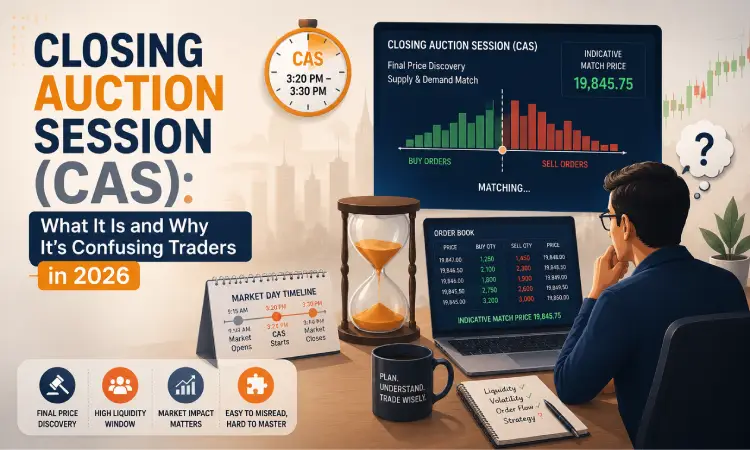
If you’ve placed an order near the market close recently and watched it behave differently than expected, you’re not imagining things. SEBI’s Closing Auction Session has changed how the last few minutes of trading actually work — and a lot of traders are still figuring out what changed and why.
What the Closing Auction Session Actually Is
The Closing Auction Session (CAS) is a short auction window introduced at the end of the trading day, designed to determine a stock’s official closing price through a call auction mechanism rather than the standard continuous order-matching that runs during regular trading hours. Instead of the closing price simply being whatever the last traded price happened to be, CAS collects buy and sell orders over a brief window and matches them at a single equilibrium price.
This isn’t unique to India — several major global exchanges use closing auctions for the same reason SEBI introduced it here: to reduce the kind of last-minute price manipulation and volatility that used to cluster in the final minutes of trading.
Why SEBI Introduced It
The Problem With the Old Closing Mechanism
Under continuous trading, the official closing price was essentially whatever trade happened to execute last — which made it vulnerable to manipulation. A trader with enough capital could place a large order in the final seconds specifically to push the closing price in a favourable direction, affecting everything from derivatives settlement to index calculations, often without needing to sustain that price for more than a moment.
What CAS Is Meant to Fix
- Reduces last-minute price manipulation, since the closing price is now determined by an aggregated auction rather than a single trade
- Improves accuracy of the closing price as a genuine reflection of buy-sell interest, not a manufactured print
- Brings India’s closing mechanism closer to global exchange standards, which matters for foreign institutional flows and index tracking
Why It’s Causing Confusion on D-Street
Orders Behave Differently in the Auction Window
During the CAS window, orders aren’t matched instantly the way they are in continuous trading. Traders used to seeing immediate execution near close have found their orders sitting unmatched until the auction resolves — which feels unfamiliar and, to some, alarming, even though it’s working as designed.
It Affects Strategies Timed Around the Close
Traders who ran strategies specifically built around the old closing mechanics — entering or exiting positions in the final seconds to capture a particular closing print — have had to rethink those strategies entirely, since the auction mechanism doesn’t reward that kind of last-second timing the same way.
Index and Derivatives Settlement References Have Shifted
Since the official closing price now comes from the auction rather than the last continuous trade, anything that references the closing price — index calculations, certain derivatives settlements, and mutual fund NAV calculations — is technically being priced off a different mechanism than before, even if the numbers look similar day to day.
What Traders Should Actually Do
- Stop placing orders in the final minutes expecting instant execution. Understand the CAS window timing and how auction matching works before relying on it.
- Re-examine any strategy built around the old closing print. If your edge depended on continuous-trading mechanics near close, that edge may no longer exist in the same form.
- Watch how your specific stocks behave during the auction window for a few sessions before trading around it confidently — liquidity and price discovery during CAS can vary by stock.
- Don’t confuse auction-window inactivity with a broken order. Orders sitting unmatched during CAS are functioning as intended, not stuck.
Why Understanding Market Structure Matters as Much as Charts
CAS is a good example of something beginners often underestimate: market structure changes can affect your trading just as much as a wrong technical read. A trader who understands how the market actually works — order matching mechanisms, settlement processes, regulatory context — adapts to changes like this far faster than one who only knows chart patterns. This kind of structural understanding is exactly what’s built into Upside’s Diploma in Stock Market, which covers how the NSE and BSE actually function, not just how to read a candle. It pairs naturally with our earlier post on Order Types Explained, since CAS is really an extension of the same order-matching logic applied specifically to the market close.
Frequently Asked Questions
What is the Closing Auction Session (CAS) in Indian stock markets? +
CAS is a short auction window at the end of the trading day where buy and sell orders are matched at a single equilibrium price to determine the official closing price, replacing the old method of using the last continuous trade.
Why did SEBI introduce the Closing Auction Session? +
To reduce price manipulation near market close and produce a more accurate, manipulation-resistant closing price, bringing India’s mechanism closer to global exchange standards.
Why does my order not execute instantly during CAS? +
Orders placed during the auction window are collected and matched together at a single price once the auction resolves, rather than being matched instantly as they are during continuous trading — this is expected behaviour, not an error.
Does CAS affect index values and derivatives settlement? +
Yes, since official closing prices now come from the auction mechanism, anything referencing the closing price — including index calculations and certain settlements — is effectively priced off this new mechanism.
Do I need to change my trading strategy because of CAS? +
If your strategy relied on timing trades around the old closing price mechanics, it likely needs to be reassessed, since the auction-based system behaves differently in the final minutes of trading.
Understand the Market Structure, Not Just the Chart
Changes like CAS are exactly why understanding how markets actually function matters as much as technical skill. Explore Upside’s Diploma in Stock Market to build that foundation, or talk to our team if you have questions about how recent changes affect your trading.