Why Mentor-Led Training Beats Learning Trading on YouTube
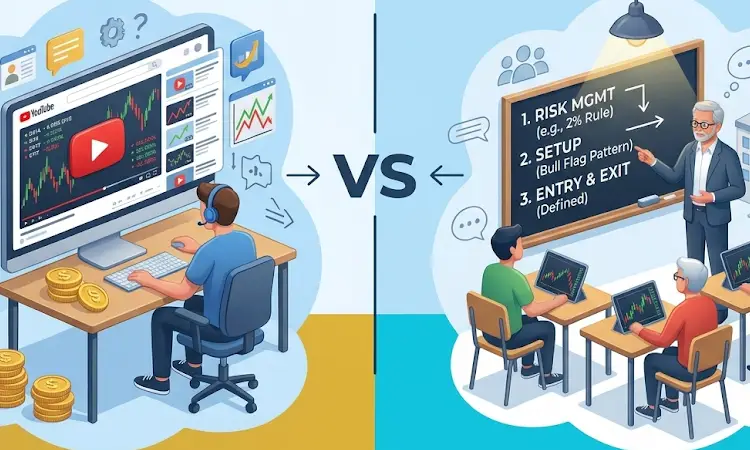
You’ve watched the videos. You’ve paused, rewound, and taken notes on candlestick patterns, RSI divergence, and “secret” breakout strategies. And yet, when you open your trading terminal with real money on the line, none of it seems to work the way it did in the video.
If this sounds familiar, you’re not alone — and you’re not doing anything wrong. The problem isn’t your effort. It’s the medium.
YouTube is an incredible tool for awareness. It is a poor tool for skill-building. There’s a fundamental difference between watching someone trade and learning to trade yourself, and that difference is exactly why mentor-led training consistently outperforms self-taught, video-based learning for anyone serious about the markets.
Let’s break down why.
The Problem With Learning Trading on YouTube
1. There’s No Curation — Just an Algorithm
YouTube’s algorithm is designed to keep you watching, not to make you profitable. It has no idea whether you’re a complete beginner or an experienced swing trader, and it doesn’t care. One video promotes intraday scalping, the next pushes long-term positional investing, and a third insists options selling is the “only strategy you’ll ever need.”
Without a structured curriculum, you end up with fragments of information — a candlestick pattern here, an indicator there — but no coherent framework connecting them. You’re collecting puzzle pieces from a hundred different puzzles and trying to force them into one picture.
Mentor-led training solves this through curation. A good mentor sequences your learning: market structure first, then risk management, then strategy, then execution — each building on the last, in an order designed for retention and application, not watch-time.
2. YouTube Can’t Give You Feedback
This is the single biggest gap, and it’s not a minor one.
You can watch a hundred videos on how to spot a false breakout, but until someone reviews your trade — the one you took, with your reasoning, your entry, your stop-loss — you have no way of knowing if you actually understood the concept or just recognized it in hindsight.
A YouTube video is a monologue. It cannot look at your chart and tell you where your analysis went wrong. It cannot spot the subtle bias in your reasoning that’s costing you money. Real feedback requires a real person watching your real trades — which is precisely what mentor-led, practical training provides. This kind of individualized correction is what turns “I think I understand this” into “I can actually do this.”
3. There’s Zero Accountability
Self-paced YouTube learning has an obvious, well-documented failure mode: you stop. Life gets busy, the market gets choppy, motivation dips — and the “learning” quietly ends, often just before the point where it would have paid off.
Mentorship builds in structure that self-study can’t replicate on its own:
- Scheduled sessions you’re expected to show up for
- Assignments and practice trades you’re expected to complete
- Someone who will ask, “How did that trade actually go?”
This accountability isn’t about pressure for its own sake — it’s about closing the gap between knowing and doing, which is where most self-taught traders get stuck for years.
The Case for Practical, Mentor-Led Training
Learning by Doing, Not Just Watching
The markets don’t reward theoretical knowledge; they reward applied judgment under pressure. That judgment is built through repetition — placing trades, reviewing outcomes, adjusting, and repeating — ideally with someone experienced pointing out what a self-taught trader would take years to notice on their own.
Structured, practical training typically includes:
- Live market sessions where strategies are applied in real time, not just described
- Trade journaling and review, so patterns in your own behavior — not just the market’s — become visible
- Simulated and guided live trades before real capital is meaningfully at risk
- Direct Q&A, so questions get answered in minutes, not left to a comment section that may never get a reply
A Mentor Adapts. A Video Cannot.
Every trader has a different risk appetite, capital base, time availability, and psychological relationship with losing money. A YouTube video plays the same regardless of who’s watching it. A mentor, on the other hand, can look at your specific situation and tell you — for example — that intraday trading might not suit someone who can only check charts twice a day, or that your position sizing is too aggressive for your account size.
This kind of personalization is impossible to scale through pre-recorded content, no matter how well-produced it is.
YouTube Still Has a Place — Just Not This One
To be fair, YouTube isn’t useless. It’s genuinely good for:
- Getting a general sense of what trading involves before committing time or money
- Staying updated on market news and broad commentary
- Revisiting a specific concept you’ve already learned properly, as a refresher
The mistake is treating YouTube as a substitute for structured education rather than a supplement to it. Awareness content and skill-building content are different categories, and confusing the two is why so many self-taught traders spend years going in circles — relearning the same concepts repeatedly without ever building consistency.
Structured Mentorship: The Faster, Safer Path
If your goal is to trade with discipline and consistency — not just to accumulate trivia about the markets — a structured, mentor-led environment will get you there faster and with far fewer expensive mistakes along the way.
That’s exactly the gap programs like the advanced diploma in stock market are built to close: curated curriculum, live practical training, direct feedback on real trades, and the accountability structure that self-study simply cannot offer.
Final Thoughts
Trading is a performance skill, much like flying a plane or performing surgery — you wouldn’t want to learn either purely from video tutorials, and the same logic applies here. Watching content builds awareness. Mentorship builds competence.
If you’ve spent months (or years) consuming trading content without seeing consistent results, the content probably isn’t the problem — the delivery method is. Structured, mentor-led, practical training closes the gap between what you know and what you can actually execute under pressure.
Ready to learn trading the right way — with curated content, live practice, and real feedback? Explore the advanced diploma in stock market and take the first step toward disciplined, mentor-guided trading.
Want to explore more on choosing the right learning path?
Check out our guide on picking the best stock market course for your goals, or visit the Upsides to see all our programs.
Still have questions? Ask your AI
Get instant answers about mentor-led training vs learning on your own — straight from the AI assistant you already use.
 ChatGPT
 Claude
 Gemini
 Perplexity
 Grok
Grok