
SIP vs Lump Sum: What the Data Actually Shows
The Question Everyone With Spare Money Eventually Asks
You’ve just received a bonus, a maturity payout, or you’ve simply saved up a decent amount. Now comes the question every Indian investor faces at some point: do you invest it all at once, or spread it out over time?
Most articles on this answer with a confident “SIP is better for discipline” or “lump sum wins in a bull market” and leave it there. Neither answer is wrong, but neither is the full picture either. Let’s actually look at what happens across real market cycles, not just one good year or one bad one.
What Each Approach Actually Means
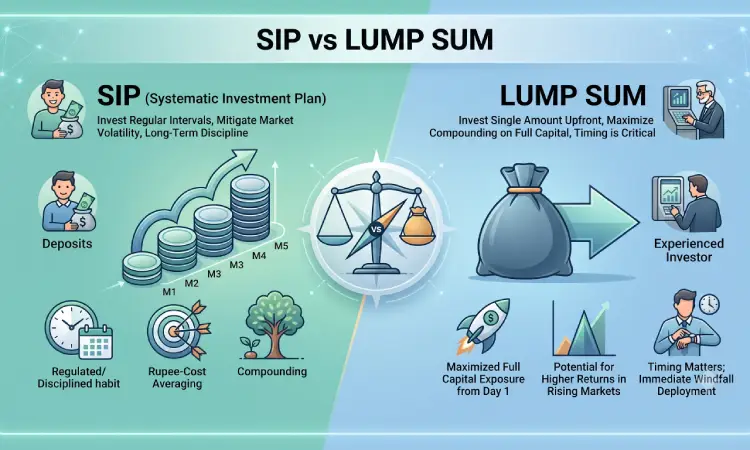
SIP (Systematic Investment Plan) means investing a fixed amount at regular intervals — usually monthly — rather than all at once. It works through rupee-cost averaging: you automatically buy more units when prices are low and fewer when prices are high, smoothing out your average entry cost over time.
Lump sum investing means deploying your entire amount in a single transaction. Your whole investment starts earning market returns immediately, for better or worse, depending on where the market happens to be that day.
Both are legitimate strategies. The debate isn’t about which one is “correct” — it’s about which conditions favor which approach, and that’s where actual data is far more useful than opinion.
What a 23-Year Study of the Nifty 50 Actually Found
One of the more rigorous analyses on this topic looked at 704 rolling return windows on the Nifty 50 from 2002 to 2025 — meaning it tested SIP against lump sum across every possible 5-year and 15-year starting point in that period, not just cherry-picked years.
The results are more nuanced than most people expect:
- Over 5-year windows, SIP won roughly 52% of the time.
- Over 15-year windows, lump sum edged ahead, also winning roughly 52% of the time.
In plain terms: it’s close to a coin flip. Neither method reliably beats the other — the actual winner depends almost entirely on the specific market regime you happen to invest into, which nobody can predict in advance.
Why the “Winner” Flips Depending on the Year You Pick
Look at any single year in isolation and you’ll get a confident, misleading answer. In 2025’s strong rising market, for example, a lump sum ₹10 lakh investment reportedly outperformed an equivalent SIP by roughly ₹42,700 over 12 months — because the full amount was exposed to the market’s entire upward move from day one, while the SIP was still averaging in gradually.
Flip the scenario, and it reverses completely. A separate look at the 2024–25 correction, when the Nifty 50 fell over 15% from its September 2024 peak before recovering in early 2026, showed SIP investors coming out ahead on average cost — they kept buying through the dip automatically — while lump sum investors who happened to deploy right before the fall took the full hit immediately.
Neither of these examples proves one method is superior. They prove the same thing the 23-year study found: outcome depends on timing, and timing is exactly what nobody can reliably control.
The Real Risk Isn’t SIP vs Lump Sum — It’s Missing the Recovery
Here’s a statistic that matters more than the SIP-vs-lump-sum debate itself: a study of the Nifty 50 Total Returns Index over 24 years found that missing just the 50 best trading days would have reduced annual returns from roughly 15.6% CAGR to under 1%.
Why does this matter here? Because the best trading days tend to cluster right after the worst ones — precisely the moments when nervous investors, whether SIP or lump sum, are most tempted to pause contributions or pull out entirely. The debate over which entry method is better becomes almost irrelevant if the real risk is exiting or pausing at the wrong moment.
So Which Should You Actually Choose?
Given the data doesn’t hand either method a decisive win, the honest answer depends on your own situation more than the market’s:
- If you’re a salaried investor without a large lump sum sitting around: SIP isn’t a compromise — it’s simply the practical, disciplined way to invest consistently without needing to time anything. It also removes the emotional burden of deciding “is now a good time to invest ₹5 lakh?”
- If you’ve received a windfall — a bonus, a maturity payout, an inheritance: A lump sum can make sense, particularly if valuations look reasonable and you have a long time horizon to ride out any near-term volatility.
- If you’re uncertain, or the market feels expensive: A hybrid approach works for many investors — deploy a portion as a lump sum and stagger the rest, or use an STP (Systematic Transfer Plan) to move a lump sum into equities gradually from a low-risk fund.
The one strategy that consistently underperforms both of these, according to every dataset above, is stopping. Pausing SIPs during a correction, or sitting on lump sum cash waiting for a “better” entry point that may never arrive in any obvious way, is what actually erodes long-term returns — far more than the choice between the two methods itself.
The Real Takeaway
SIP and lump sum aren’t rivals with a permanent winner — they’re two tools that perform differently depending on market conditions nobody can predict with certainty. What the data consistently rewards isn’t cleverness about timing, it’s simply staying invested through both the falls and the recoveries that inevitably follow them.
Knowing this is useful, but knowing how to actually read market conditions, valuations, and when equity allocation genuinely makes sense for your goals is a deeper skill that data alone won’t teach you. If you want to build that understanding properly, Upside’s Fundamental Analysis course covers how to evaluate markets and companies with real rigor — the foundation for any investment decision, SIP or lump sum.
Frequently Asked Questions
Is SIP always better than lump sum investing? No. Data on Nifty 50 rolling returns shows SIP wins slightly more often over 5-year windows, while lump sum edges ahead more often over 15-year windows. Neither consistently dominates — outcomes depend heavily on the market regime during the investment period.
When does lump sum investing tend to perform better? Lump sum tends to perform better in sustained bull markets, since the entire investment benefits from upward momentum from day one, without the gradual averaging-in period that SIP involves.
When does SIP investing tend to perform better? SIP tends to perform better during volatile or declining markets, since rupee-cost averaging allows you to buy more units at lower prices during dips, reducing your average cost over time.
What matters more than choosing between SIP and lump sum? Staying invested. Data shows that missing just the best 50 trading days over a 24-year period can reduce annual returns from roughly 15.6% to under 1% — a far bigger factor than which entry method was used.
Can I combine SIP and lump sum investing? Yes. Many investors use a hybrid approach — investing a portion as a lump sum and staggering the rest through an SIP or a Systematic Transfer Plan (STP), particularly when unsure about current market valuations.
What is rupee-cost averaging in a SIP? It’s the mechanism where a fixed investment amount buys more units when prices are low and fewer units when prices are high, smoothing your average purchase cost over time rather than locking in a single entry price.