
India’s T+1 Settlement Cycle: What Really Happens in the 24 Hours After You Trade
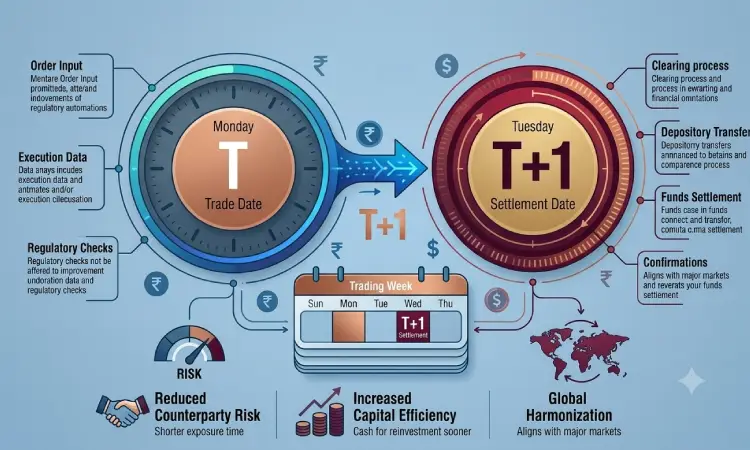
The Moment That Confuses Every New Trader
You buy 50 shares at 11 am. The order screen says “executed.” Relief washes over you — until you open your demat account five minutes later and the shares aren’t there.
Panic sets in. Did the order fail? Did the money get deducted for nothing? Should you call your broker?
Take a breath. Nothing went wrong. You’ve just met the settlement cycle — the 24-hour gap between “the trade happened” and “the shares and money are actually yours.” Almost every trader hits this moment once. Here’s exactly what’s going on behind the scenes.
What T+1 Actually Means (And What It Doesn’t)
“T” stands for trade day — the day your order executes. “+1” means the actual handover of shares and money happens one business day later. India has run on this cycle for every equity trade since January 2023.
That’s it. That’s the whole concept. The confusion only starts because most people assume “executed” means “done.” It doesn’t.
A Timeline You Can Actually Picture
Say you buy shares on Monday:
- Monday (T day): Your order executes. The trade is locked in and legally binding. Shares aren’t in your demat account yet.
- Tuesday (T+1 day): Shares land in your demat account. If you’d sold instead, this is when the money hits your account.
Same rule, either direction. Buy or sell, the actual transfer always lags the trade by one business day.
T+1 vs T+0 — Don’t Confuse the Two
Here’s where most explainers get sloppy. T+1 is not instant settlement. It’s just faster than the old two-day cycle.
A separate facility called T+0 does offer same-day settlement — but only for a limited, slowly expanding list of stocks, and only for trades placed within a strict intraday window. Unless you’ve specifically opted into T+0 for an eligible stock, you’re on T+1. That covers the vast majority of what you trade.
So Who’s Actually Moving Your Shares and Money?
Here’s the part nobody explains: you’re not settling directly with the person on the other side of your trade.
Every trade on NSE or BSE passes through a clearing corporation — NSCCL for NSE, ICCL for BSE. It steps in as the central counterparty to every single trade in the market. In plain terms: it becomes the buyer to every seller, and the seller to every buyer.
Why does that matter to you? Because your settlement doesn’t depend on whether the specific stranger who sold you those shares actually delivers them on time. The clearing corporation guarantees it regardless. You’re trading with a guarantor, not a stranger.
Netting — Why the Market Doesn’t Drown in Paperwork
Millions of trades happen every day. If each one settled individually, the system would collapse under its own weight.
Instead, the clearing corporation nets off all your buys and sells through your broker for the day, landing on one final number — shares owed, or funds owed. One net obligation instead of hundreds of separate transfers. This is what keeps a market this size operationally possible.
Pay-In and Pay-Out: The Actual Handover
This is where the shares and money actually move. It happens in two connected steps on T+1 morning.
Pay-in is the deadline by which:
- Sellers must have their shares ready for delivery through their depository participant
- Buyers must have funds available with their broker
Pay-out happens right after pay-in closes:
- Shares get released into buyers’ demat accounts
- Funds get released to sellers’ trading accounts
Both stages run on T+1, managed tightly by the depositories — NSDL and CDSL — and clearing banks. This is exactly why your holdings can look “incomplete” for a few hours after a trade. The trade is real. The transfer just hasn’t finished its cycle yet.
What Happens If a Seller Doesn’t Deliver?
Rare, but it happens — a seller fails to deliver shares by the pay-in deadline. This is called short delivery.
When it does, the clearing corporation runs an auction, buys the shares from the open market, and delivers them to the buyer anyway. Your pay-out doesn’t get held hostage by someone else’s failure. That guarantee is the entire reason clearing corporations exist.
A Short History: From Weekly Settlement to T+1
India didn’t jump to T+1 overnight. Settlement here has been getting faster for two decades:
- Before 2001: Weekly settlement — trades bundled and settled once a week
- 2001–2002: Rolling settlement begins, starting at T+5
- 2002: Shortened to T+3
- 2003: Aligned with global standard at T+2, which held for nearly 20 years
- January 2023: India moves to T+1 for all equities — ahead of the US, which only got there in 2024
Each step shortened the window where risk could pile up. T+1 is simply the fastest version yet.
Why This Actually Changes How You Trade
This isn’t trivia. It affects real decisions:
- Fund availability: Sell today, and that money isn’t usable for a fresh buy or a withdrawal until T+1 pay-out completes.
- BTST trades: “Buy Today, Sell Tomorrow” works because your purchase is confirmed on T day even before the shares hit your demat account — but it carries a small risk if the original delivery chain fails and triggers an auction.
- Holdings that look “off”: Nothing’s broken. You’re just mid-cycle.
- Global edge: India moved to T+1 in January 2023. The US didn’t manage it until May 2024. That’s not a small gap — it’s a genuine head start in reducing counterparty risk for every retail investor here.
The Real Takeaway
T+1 isn’t a delay working against you. It’s the safety net working for you — a guaranteed, verified handover instead of a same-day scramble that trusts strangers to deliver on time.
Once you see it that way, the “gap” stops feeling like something’s wrong. It’s just the market doing its job properly.
This is exactly the kind of foundational mechanic that separates traders who understand the market from traders who just click buttons on it. If you want to build that understanding properly — from settlement mechanics to real trading and investing skills — Upside’s stock market courses cover it step by step, not as a footnote.
Frequently Asked Questions
What does T+1 settlement mean in simple terms? A trade executed on one business day (T) is settled — shares and funds actually change hands — on the next business day (T+1). Buy shares Monday, they land in your demat account Tuesday.
Is T+1 the same as instant settlement? No. It’s faster than the older T+2 cycle, but not instant. Same-day settlement (T+0) exists only as a separate, optional facility for select stocks.
What does a clearing corporation actually do? It acts as the guarantor for every trade — becoming the buyer to every seller and the seller to every buyer — so your settlement doesn’t depend on the other party’s reliability.
What is pay-in and pay-out? Pay-in is the deadline for sellers to deliver shares and buyers to arrange funds. Pay-out is when the clearing corporation releases those shares and funds to the right accounts. Both happen on T+1.
What if a seller doesn’t deliver shares on time? The clearing corporation runs an auction, sources the shares from the market, and delivers them to the buyer anyway. Your settlement isn’t affected by someone else’s failure.
Does T+1 apply to mutual funds too? No. T+1 here refers specifically to equity cash market trades. Mutual funds follow their own separate settlement timelines.