
How Stock Prices Are Determined: Supply, Demand and the Order Book
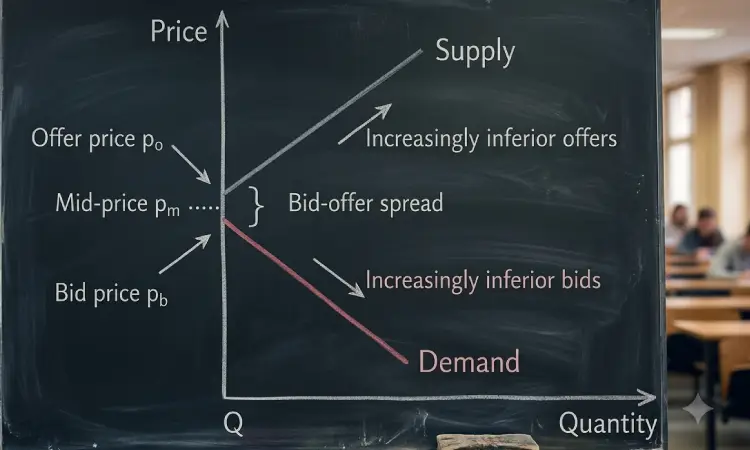
Ask most people why a stock went up and you’ll hear something like: “the company posted good results.”
That answer isn’t wrong, exactly. But it skips the entire machine in the middle. Good results don’t move a price. People reacting to good results move the price — and they do it through a specific, mechanical, surprisingly unglamorous piece of infrastructure called the order book.
Once you can see the order book, the market stops looking like weather and starts looking like plumbing. That shift is the single biggest step from “I follow the market” to “I understand the market.”
Here’s how it actually works.
The one-sentence answer
A stock’s price is simply the price at which the last trade happened.
That’s it. There’s no committee. No formula. Nobody at the NSE decides that Stock XYZ is worth ₹500 today. The screen shows ₹500 because the most recent buyer and the most recent seller agreed on ₹500, and the exchange recorded it.
Which means the real question isn’t “what determines the price.” It’s “how do a buyer and a seller find each other and agree?”
That happens in the order book.
The order book: the market’s actual engine
Every stock has one. It’s a live, two-sided list of everyone currently waiting to trade — what they want, how much, and at what price.
- Bids = buyers, and the highest price each is willing to pay
- Asks (or offers) = sellers, and the lowest price each is willing to accept
Here’s a simplified order book for a stock trading around ₹500:
| Buyers (Bids) | Sellers (Asks) | ||
|---|---|---|---|
| Qty | Price | Price | Qty |
| 250 | ₹499.90 | ₹500.10 | 180 |
| 400 | ₹499.85 | ₹500.15 | 520 |
| 1,200 | ₹499.80 | ₹500.20 | 300 |
| 800 | ₹499.75 | ₹500.25 | 900 |
| 1,500 | ₹499.70 | ₹500.30 | 1,100 |
Read it carefully, because everything else in this article follows from it.
The best bid is ₹499.90 — the most anyone is currently willing to pay. The best ask is ₹500.10 — the least anyone is currently willing to accept.
Notice the problem: nobody wants to trade. The highest buyer won’t go above ₹499.90. The cheapest seller won’t come below ₹500.10. They’re 20 paise apart and both are standing still.
So no trade happens. The price sits.
Until somebody gets impatient.
The bid-ask spread
That 20-paise gap between ₹499.90 and ₹500.10 is the bid-ask spread. It is the cost of impatience, and it is the most under-appreciated number on a beginner’s screen.
If you want to buy right now, you can’t buy at ₹499.90 — nobody’s selling there. You have to pay ₹500.10. If you want to sell right now, you receive ₹499.90, not ₹500.10.
Buy and immediately sell, and you’ve lost 20 paise per share without the price moving at all. That’s not a fee your broker charged you. It’s the structure of the market.
A narrow spread means a healthy, busy stock. A wide spread — say ₹8 on a ₹500 stock — is a warning: few participants, and a real cost every time you enter or exit.
Beginners obsess over brokerage. Brokerage is visible. The spread is invisible, and on illiquid stocks it will quietly cost you far more.
Market depth: looking past the first row
The order book above shows five levels on each side. In India, this is what your broker’s terminal displays as market depth — typically the best five bids and five asks. (Deeper 20-level feeds exist for those who need them.)
Depth answers a question the last-traded price cannot: how much can this stock absorb before it moves?
Look again. There are only 180 shares available at ₹500.10. If you want 1,000 shares, that first row cannot fill you. You’ll eat into ₹500.15, then ₹500.20 — and in doing so, you will push the price up yourself.
The best bid and best ask tell you where the market is. Depth tells you how solid that price actually is. A price with 200 shares behind it and a price with 200,000 shares behind it look identical on a chart and behave nothing alike.
Market orders vs limit orders: the choice that costs beginners money
Two ways to enter that book. They are not interchangeable, and most beginners pick wrong.
A limit order says: “this price or better.”
You want 1,000 shares at ₹499.80. Your order joins the book as a bid. You control the price. You do not control whether it fills. If the stock walks away, you get nothing.
A market order says: “any price. Just fill me. Now.”
You control the fill. You do not control the price. And here’s what that actually means:
You place a market buy for 1,000 shares against the book above. You do not get 1,000 at ₹500.10. You get:
- 180 shares @ ₹500.10 = ₹90,018
- 520 shares @ ₹500.15 = ₹2,60,078
- 300 shares @ ₹500.20 = ₹1,50,060
Total: ₹5,00,156 — an average of ₹500.156 per share.
You expected ₹500.10. You paid ₹500.16. That ₹56 gap is slippage, and on a thin stock in a fast market it will be far worse than 6 paise.
And look what you did to the book: ₹500.10, ₹500.15 and ₹500.20 are now empty. The best ask is ₹500.25.
You didn’t just buy the stock. You moved it.
That’s the whole lesson. The price didn’t rise because the company got better in those two seconds. It rose because a buyer consumed the available supply. Multiply that across thousands of participants all day, and you have a chart.
How a trade actually gets matched
The exchange follows one rule: price-time priority.
- Price first. The best-priced order wins. A bid at ₹499.90 is ahead of a bid at ₹499.85, always.
- Time second. Among orders at the same price, whoever queued first gets filled first.
That’s it. No favouritism, no discretion. If you and I both bid ₹499.80 and you placed yours a second earlier, you get filled first. This is also why a limit order at the same price as fifty others may never fill — you’re fiftieth in a queue you can’t see.
Liquidity: the thing that decides everything else
Liquidity is simply how easily you can trade meaningful size without moving the price.
It’s not a footnote. It silently determines the spread, the depth, your slippage and your ability to exit when it matters.
A highly liquid stock: spread of a few paise, thousands of shares at every level, your order barely registers.
An illiquid stock: spread of rupees, a handful of shares per level, and your modest order shunts the price several percent. The chart shows a “breakout.” There was no breakout. There was you.
This is why illiquid small-caps punish beginners. Getting in feels effortless. Getting out — on a red day, when everyone wants out at once and the bids have simply vanished — is a different experience entirely. The price you see is not a promise. It’s just where the last two people agreed. If nobody’s there when you need to sell, that number means nothing.
Price discovery: watch it happen in the pre-open
Everything above describes continuous trading. But the clearest view of supply and demand setting a price happens every morning between 9:00 and 9:15 AM, in the pre-open session — and almost no beginner watches it.
Overnight news hits, but the market’s shut. If trading simply opened at 9:15, the first seconds would be chaos. So the NSE runs a call auction instead, in three phases:
- 9:00 – 9:08 — Order collection. Everyone submits orders. Nothing executes yet. (The window shuts at a random moment between the 7th and 8th minute, so nobody can game the close.) Note: stop-loss and IOC orders aren’t accepted here.
- 9:08 – 9:12 — Order matching. No new orders, no changes. The exchange calculates the opening price.
- 9:12 – 9:15 — Buffer. A quiet transition into the normal market.
How does it pick the opening price? By the simplest possible principle: it finds the price at which the maximum number of shares can actually change hands.
Not the average of the orders. Not yesterday’s close plus sentiment. The price where supply and demand overlap most. If two prices tie, it picks the one leaving the least unmatched quantity; if they still tie, the one nearest the previous close.
That’s price discovery in its purest form — thousands of independent opinions, resolved into one number by nothing more than arithmetic.
It’s also a good argument for limit orders. Participation is thinner in the pre-open, spreads are wider, and a gap on overnight news can carry your market order somewhere you never intended.
(NSE extended a pre-open session to current-month index and stock futures from December 2025.)
One more thing: prices move on a grid
Prices can’t move by any arbitrary amount. They move in ticks — the minimum increment the exchange accepts.
This is where a lot of older guides will mislead you. India no longer uses a flat ₹0.05 tick for everything. NSE moved to a price-linked tick regime: cheaper stocks now tick in single paise, more expensive ones in larger increments, revised across 2024 and 2025 (with stock options moving to a price-linked structure in November 2025). A stock’s applicable band is reviewed monthly, so a stock can change tick bucket as its price moves.
Why should a beginner care? Because the tick sets the minimum possible spread. A ₹0.05 tick on a ₹30 share forces a spread of roughly 0.17% — before anything else. On a ₹3,000 share, the same tick is almost invisible. That asymmetry is exactly why the rules were revised.
Always confirm the live tick before building anything tight around it. Don’t trust an article — including this one. Check NSE.
What this actually changes for you
Once you can read a book, a few things stop being mysterious:
- A chart is a receipt, not a cause. Every candle is the residue of orders consuming other orders.
- “Support” and “resistance” have a physical meaning. Often, they’re places where real size is sitting in the book.
- Volume without depth is noise. So is a breakout on an illiquid counter.
- Your order is part of the market, not an observer of it.
This is the foundation everything else sits on. Reading price action, spotting genuine levels, sizing a position so you don’t become your own worst counterparty — all of it assumes you understand what the number on the screen actually represents.
If you want to learn to read this properly, in a classroom, with live market hours and someone to stop you mid-mistake, that’s what our technical analysis course is built for.
FAQs
Who decides a stock’s price? Nobody. It’s the price of the last completed trade — the point where a buyer and seller agreed. The exchange records it; it doesn’t set it.
What is the bid-ask spread in simple terms? The gap between the highest price a buyer will pay and the lowest a seller will accept. It’s the cost of trading immediately, and it’s separate from brokerage.
What does market depth show me? The queue of pending orders at each price. It tells you how much a stock can absorb before the price moves — information the last-traded price hides completely.
Should beginners use market orders or limit orders? Limit orders, as a default, especially on illiquid stocks and in the pre-open. A market order guarantees a fill, never a price.
Why did the price move when there was no news? Because someone traded. Prices move on order flow, not on headlines. News is one reason people place orders — not the only one, and never the mechanism.
How is the opening price decided? Through a pre-open call auction between 9:00 and 9:15 AM, which finds the single price allowing the maximum quantity to trade.