
Commodity Trading in India: How MCX Works for Beginners
If you’ve ever wondered how traders profit from the price of crude oil, gold, or even cotton without ever touching a barrel or a bar of bullion, the answer lies in commodity trading India‘s biggest exchange: the Multi Commodity Exchange, or MCX. For beginners, commodity trading can seem more intimidating than stock trading — different contract structures, different terminology, different risk dynamics. But once you understand the basics, it follows a logic that’s actually quite approachable. Before diving into commodities specifically, it helps to have a grounding in the markets more broadly through structured stock market courses.
This post breaks down what MCX is, how commodity contracts work, what margins mean in practice, and which commodities are most commonly traded in India.
What Is MCX?
The Multi Commodity Exchange of India (MCX) is the country’s leading commodity derivatives exchange, where traders buy and sell futures contracts based on the future price of physical commodities — without ever needing to take delivery of the actual goods (unless they specifically choose a delivery-based contract). MCX is regulated by SEBI (Securities and Exchange Board of India), the same regulator that oversees the stock market, which means it operates under a similarly structured framework of rules, margin requirements, and settlement processes.
Think of MCX as the commodities equivalent of the NSE or BSE — except instead of trading shares of companies, you’re trading contracts tied to the price of raw materials and metals.
How Commodity Futures Contracts Work
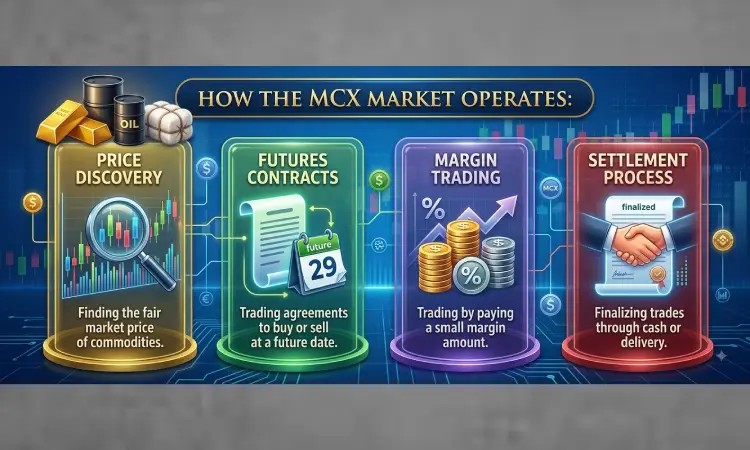
A commodity futures contract is an agreement to buy or sell a specific quantity of a commodity at a predetermined price, on a set future date. When you trade commodity futures, you’re not usually planning to take physical delivery — most retail traders square off their positions before the contract expires, profiting (or losing) from the price movement in between.
Each commodity on MCX has:
- A standardized lot size — the fixed quantity per contract (for example, a set number of kilograms of silver or barrels of crude oil)
- An expiry date — contracts expire monthly, and traders need to either close their position or roll it over before expiry
- A tick size — the minimum price movement the contract can make, which determines how gains and losses are calculated
Understanding these mechanics is essential before placing your first trade — the same contract, priced correctly, can lead to very different outcomes depending on lot size and how much capital you’re putting behind it.
Understanding Margins in Commodity Trading
One of the most important concepts for beginners to grasp is margin. Unlike buying a stock outright, commodity futures trading is leveraged — you only need to deposit a percentage of the total contract value (the margin) to open a position, rather than paying the full value upfront.
This works in two ways:
- It amplifies your buying power — a relatively small margin lets you control a much larger contract value.
- It amplifies your risk — losses are also calculated on the full contract value, not just the margin you put down.
This is exactly why risk management — stop-losses, position sizing, and never over-leveraging — becomes even more critical in commodity trading than in straightforward stock investing. Margin requirements vary by commodity and are set by the exchange, and they can change during periods of high volatility, so it’s important to stay updated rather than assuming a fixed number.
Popular Commodities Traded on MCX
MCX offers contracts across several broad categories:
- Bullion — Gold and Silver, in various contract sizes from full Standard lots down to Mini and Micro contracts for smaller retail participation
- Energy — Crude Oil and Natural Gas, both known for higher volatility due to their sensitivity to global supply and geopolitical events
- Base Metals — Copper, Zinc, Aluminium, Lead, and Nickel, widely used across industrial and infrastructure sectors
- Agricultural Commodities — including Cotton, Mentha Oil, and a few others, though the range here is more limited compared to bullion and energy
Each of these categories behaves differently. Bullion tends to respond to interest rates and currency movements, energy is driven heavily by geopolitics and inventory data, and base metals often track global industrial demand and manufacturing cycles.
How Commodity Trading Differs from Equity Trading
A common question beginners ask is how commodity trading compares to trading stocks. The core skills — chart reading, understanding trends, managing risk — carry over between the two. But the underlying drivers are fundamentally different: a stock’s price reflects a company’s earnings, growth, and sector outlook, while a commodity’s price reflects global supply-demand balances, geopolitical events, and macroeconomic factors like currency strength and interest rates. We’ve covered this distinction in more depth in our post on commodity vs equity trading, which is worth reading if you’re deciding where to focus your energy first.
A Closer Look at Two Popular Commodities
If you want to go deeper into specific commodities rather than the market structure as a whole, we’ve written detailed breakdowns of two of the most actively traded instruments on MCX:
- Crude oil trading and the factors that drive prices — covering OPEC decisions, inventory data, and why crude tends to be more volatile than other commodities
- How to trade gold and silver on Indian markets — covering MCX gold and silver contract sizes, price drivers, and how bullion is used for hedging
Both of these build directly on the MCX fundamentals covered in this post.
Getting Started With Commodity Trading
Commodity trading isn’t necessarily harder than stock trading, but it does require learning a distinct set of mechanics — contract sizes, margin calculations, expiry cycles, and commodity-specific price drivers. Jumping in without this foundation is one of the most common ways beginners take on more risk than they realize. Our structured commodity market course is designed to walk you through exactly this: how MCX contracts work, how margins and lot sizes are calculated, and how to build a disciplined approach across bullion, energy, and base metals.
Key Takeaways
- MCX is India’s primary commodity derivatives exchange, regulated by SEBI, where traders buy and sell futures contracts on commodities like gold, crude oil, and copper.
- Commodity futures are standardized by lot size, expiry date, and tick size — understanding these is essential before trading.
- Margin trading amplifies both potential gains and potential losses, making risk management especially important in commodities.
- Popular categories on MCX include bullion, energy, base metals, and select agricultural commodities, each with different price drivers.
- A solid understanding of MCX fundamentals makes it much easier to specialize in specific commodities like crude oil or gold and silver later on.
Ready to understand commodity trading properly before you start? Explore Upside’s commodity market course or browse our full range of stock market courses to find the right starting point for your trading journey.
Frequently Asked Questions (FAQs)
What is MCX in the stock market? MCX (Multi Commodity Exchange) is India’s leading exchange for trading commodity derivatives like gold, silver, and crude oil.
How does MCX trading work for beginners? Open a commodity trading account with a broker, then buy or sell futures contracts based on market demand and supply.