Commodity vs Equity Trading: Key Differences
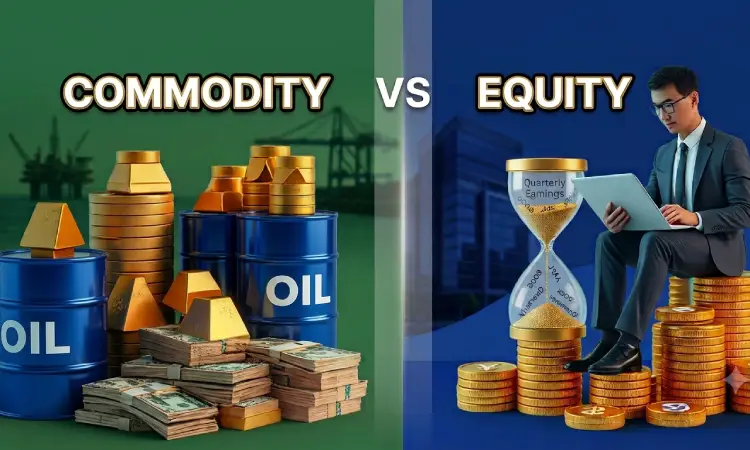
If you’ve spent any time researching stock market courses, you’ve probably noticed that “trading” isn’t one single skill — commodities and equities are traded on different exchanges, react to different forces, and demand different risk management altogether. Treating them as interchangeable is one of the more common mistakes new traders make.
This guide breaks down the practical differences — trading hours, what actually moves prices, leverage, and volatility — so you can understand which market fits your goals, or how to approach both without confusing one for the other.
What’s Actually Being Traded
The starting difference is the most basic one: equities represent ownership. When you buy a stock, you own a small slice of a company — its earnings, its growth, its risk. Commodities represent physical goods: crude oil, gold, natural gas, agricultural produce. You’re not buying a share of a company; you’re taking a position on the price of a raw material, almost always through futures or derivative contracts rather than physical delivery.
This single distinction is the root of most of the differences that follow.
Trading Hours
Equity markets run on fixed exchange hours — in India, the NSE and BSE operate within a defined daily window, with pre-open and post-close sessions bookending the core trading day.
Commodity markets tend to run longer. Exchanges like the MCX typically operate in two sessions, with trading extending well into the evening — partly because many commodities are priced off international benchmarks that trade almost around the clock (crude oil and gold, for instance, are influenced by global sessions in London and New York).
Practically, this means commodity markets can react to overnight international news before equity markets even open the next day — something equity traders need to watch for as an early signal, and commodity traders need to actively manage as an overnight risk.
What Drives Prices
Equities: Company and Sector-Specific Factors
- Quarterly earnings and management guidance
- Sector trends and competitive positioning
- Broader economic indicators (interest rates, inflation, GDP growth)
- Company-specific news — leadership changes, regulatory action, product launches
Commodities: Supply, Demand, and Global Events
- Weather and seasonal patterns (especially for agricultural commodities)
- Geopolitical events — conflicts, sanctions, and trade policy, particularly for crude oil
- Currency movements, since most commodities are priced in US dollars globally
- Central bank activity and inflation expectations, which heavily influence gold and silver
A practical consequence: equity analysis leans on studying a company’s fundamentals, while commodity analysis leans more on macro and geopolitical awareness. A trader who’s excellent at reading balance sheets isn’t automatically equipped to trade crude oil — the skill set only partially overlaps.
Leverage
Commodity trading, conducted through futures contracts, typically involves higher built-in leverage than equity cash-market trading. A relatively small margin controls a much larger contract value, which means price movements are amplified in both directions.
This isn’t inherently good or bad — leverage is simply a multiplier. It multiplies gains on a favorable move and losses on an unfavorable one at the same rate. For new traders, this is exactly why commodities are generally considered to require more disciplined risk management than plain equity investing, where leverage (if used at all) tends to be more limited and optional.
Volatility
Commodities are often more volatile than broad equity indices on a day-to-day basis, largely because a single geopolitical headline or supply disruption can move a commodity’s price sharply, whereas a diversified equity portfolio tends to absorb company-specific shocks more gradually.
Individual stocks can, of course, be just as volatile as commodities — particularly smaller-cap or event-driven names. The more useful comparison isn’t “equities vs commodities” in the abstract, but rather understanding that both markets have volatile and relatively calmer segments, and knowing which segment you’re actually trading.
Which Should You Learn First?
There’s no universally correct answer, but a few practical considerations help:
- If you want to build a long-term investing habit alongside trading, equities offer a more natural entry point, since fundamentals-based analysis transfers directly to investing
- If you’re drawn to macro events, global news, and shorter-term price swings, commodities may suit your interests — provided you’re equally comfortable with the higher leverage involved
- Many experienced traders eventually trade both, but almost always after building risk management discipline in one market first
Whichever path you choose, the underlying skills — risk management, reading price action, controlling emotion under pressure — take real time to build. If you’re mapping out how long that process realistically takes, our breakdown of realistic timelines for learning the stock market applies just as much to commodities as it does to equities.
Quick Comparison
- Ownership: Equities represent company ownership; commodities represent a position on raw material prices
- Hours: Equities trade within fixed exchange hours; commodities often trade longer, tracking global sessions
- Price drivers: Equities respond to company and economic data; commodities respond to supply, demand, and geopolitics
- Leverage: Commodity futures typically carry higher built-in leverage than cash equities
- Volatility: Both markets have volatile segments, but commodities are more exposed to sudden macro and geopolitical shocks
Final Thoughts
Commodity and equity trading aren’t different flavors of the same skill — they’re related but distinct disciplines, each with their own rhythm, risk profile, and analytical approach. Understanding these differences upfront helps you choose a starting point that actually matches your interests and risk tolerance, instead of assuming that skill in one market automatically transfers to the other.
If you want to build a solid foundation in either market — or both — explore Upsides’ stock market training programs for a structured way to learn the mechanics, risk management, and strategy each market actually demands.
Frequently Asked Questions (FAQs)
What is the difference between commodity and equity trading? Equity trading involves company shares; commodity trading involves contracts on physical goods like gold or crude oil — they differ in hours, volatility, and settlement.
Still have questions? Ask your AI
Get instant answers about commodity vs equity trading — straight from the AI assistant you already use.
 ChatGPT
 Claude
 Gemini
 Perplexity
 Grok
Grok