
Fibonacci Retracement Explained: How to Use Fibonacci Levels
Introduction
Every trader searches for the “perfect” entry, but markets rarely move in a straight line. They breathe—they push forward and then pull back. This is where Fibonacci Retracement comes into play. Whether you are performing intraday trading or swing trading, understanding these levels can significantly improve your precision and risk-reward ratio.
What is Fibonacci Retracement?
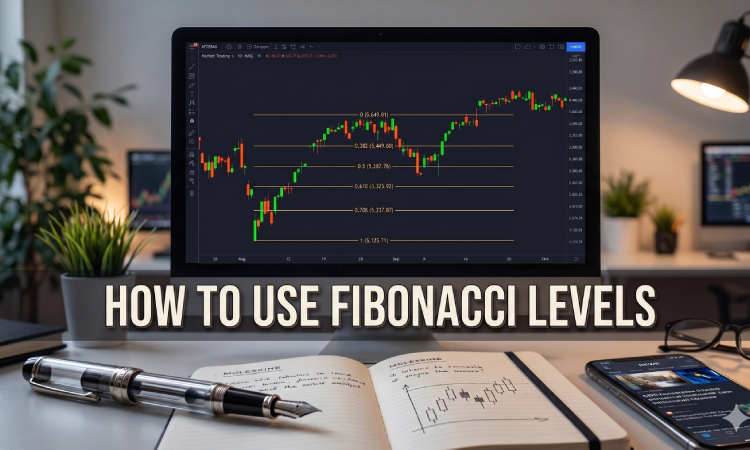
Fibonacci retracement is a technical analysis tool based on the Fibonacci sequence—a series of numbers found throughout nature and architecture. In the stock market, these ratios appear to predict areas where price is likely to pause or reverse.
The Most Important Levels:
- 38.2%: A shallow pullback; indicates a very strong trend.
- 61.8% (The Golden Ratio): The most watched level in the world; high-probability bounce zone.
- 78.6%: A deep retracement; the “last line of defense” before the trend potentially fails.
How to Use Fibonacci in the Indian Market
On the National Stock Exchange (NSE), Fibonacci is exceptionally useful for index trading (Nifty/Bank Nifty).
- Identify the Swing: Locate a clear “Swing Low” (the bottom) and “Swing High” (the top).
- Plot the Tool: Drag the tool from the low to the high (in an uptrend).
- Watch the Zones: Do not enter as soon as price touches a level. Wait for price action confirmation, such as a hammer or engulfing candle, at that level.
Fibonacci as a Swing Trading Tool
Fibonacci is a “gold mine” for swing traders who have day jobs. Why?
- Patience: You don’t have to chase the breakout. You can set “limit orders” at Fibonacci levels and let the market come to you.
- Less Stress: It helps you hold trades with confidence because you know exactly where the “trend invalidation” point is.
- Clear Structure: It eliminates the guesswork of “where should I buy?”
Common Mistakes to Avoid
- Sideways Markets: Fibonacci only works in trending markets. If the market is moving sideways, avoid it.
- Ignoring Context: Fibonacci is not a magic crystal ball. Always confirm these levels with support and resistance.
- Blind Trading: Never buy simply because the price hit 61.8%. Use it as a zone of interest, not as a standalone signal.
Master Fibonacci with Upside Stock Market Institute
Fibonacci is easy to plot but hard to master without the right guidance. At Upside, we focus on the “logic of the pullback.”
- Structured Roadmap: Join our Advance Diploma in Stock Market to learn retracement strategies from scratch.
- Practical Execution: Learn to combine Fibonacci with Smart Money Concepts and volume analysis.
- Personalized Feedback: Get your trades reviewed by mentors who understand the Indian markets.
- Flexible Access: Visit our share market classes in Mumbai or learn via our high-quality online platform.
Conclusion
Fibonacci retracement is one of the most structured ways to trade. It turns a chaotic chart into a series of clear “Buy” and “Sell” zones. However, like any tool, it requires discipline and confirmation. Practice plotting these levels on your favorite stocks, and you will soon see why “The Golden Ratio” is a favorite among professional traders worldwide.
Frequently Asked Questions (FAQs)
1. Which Fibonacci level is the most important? The 61.8% level, often called the “Golden Ratio,” is historically the most respected level by institutional traders.
2. Can I use Fibonacci for intraday trading? Absolutely. It works very well on 15-minute and 30-minute timeframes for catching intraday pullbacks.
3. Why does price sometimes break through Fibonacci levels? If a level breaks with high volume, it means the trend has lost its strength. That is why risk management is always more important than the indicator itself.
4. Where is the best place to learn technical trading in Mumbai? Upside Stock Market Institute is highly regarded for its practical, results-driven approach to technical analysis.