
Equity, Debt and Derivatives: Understanding the Three Pillars of Indian Markets
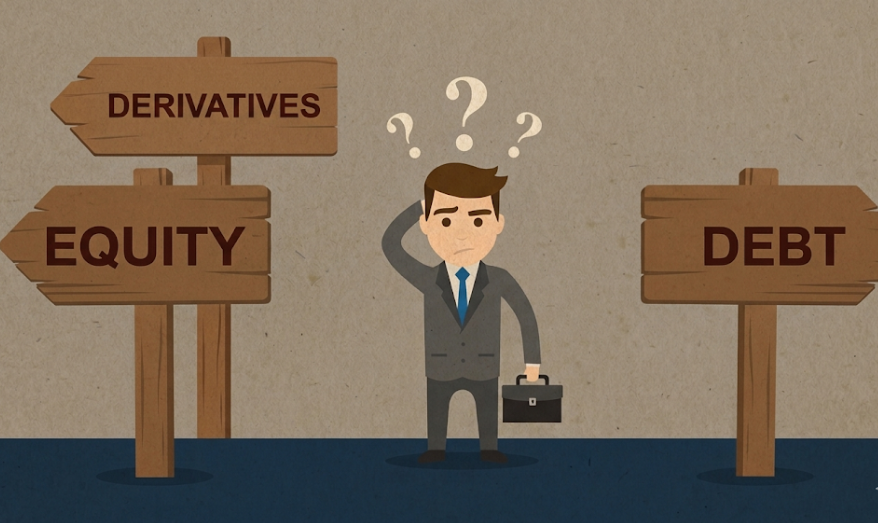
The Indian financial market is divided into three core segments — equity (ownership in companies), debt (fixed-income instruments like bonds), and derivatives (contracts based on the value of underlying assets). Each segment serves a different purpose, carries a different level of risk, and attracts a different type of investor or trader.
When most people think about the stock market, they picture share prices flashing on a screen. But the Indian financial market is far broader than just buying and selling company shares. It is built on three fundamental pillars — equity, debt, and derivatives — each with its own mechanics, risk profile, and purpose.
Understanding all three is not just academic knowledge. It directly affects how you build a portfolio, how you manage risk, and which instruments you choose to grow your wealth over time.
The Indian Financial Market — A Quick Overview
India’s financial markets are regulated by SEBI (Securities and Exchange Board of India) and operate primarily through two exchanges — the National Stock Exchange (NSE) and the Bombay Stock Exchange (BSE). Both exchanges facilitate trading across all three market segments.
Each segment serves a different economic function:
- Equity markets help companies raise capital from the public
- Debt markets help governments and corporations borrow money
- Derivatives markets help investors and traders hedge risk or speculate on price movements
Think of it like a city with three different districts — each district has its own rules, its own residents, and its own purpose, but they are all part of the same financial ecosystem.
Segment 1: The Equity Market
What Is Equity?
Equity means ownership. When a company lists its shares on a stock exchange, it is offering a piece of ownership to the public in exchange for capital. When you buy shares of a company, you become a shareholder — a part-owner of that business.
Your returns from equity come in two forms:
- Capital appreciation — the share price increases over time
- Dividends — the company distributes a portion of its profits to shareholders
How the Equity Market Works in India
The equity market in India has two sub-segments:
Primary Market — This is where companies raise fresh capital by issuing new shares to the public for the first time through an Initial Public Offering (IPO). When you apply for an IPO, you are buying shares directly from the company.
Secondary Market — Once shares are listed on the exchange, they trade between buyers and sellers on the stock exchange. This is what most people refer to when they say “the stock market.” The price of a share in the secondary market is determined by supply and demand.
Key Indices in India’s Equity Market
- Nifty 50 — Tracks the top 50 companies listed on the NSE
- Sensex — Tracks the top 30 companies listed on the BSE
- Nifty Midcap 150 — Tracks mid-sized companies
- Nifty Smallcap 250 — Tracks smaller companies
Risk and Return Profile
| Factor | Details |
|---|---|
| Risk Level | Moderate to High |
| Return Potential | High (historically 12–15% CAGR for long-term equity) |
| Holding Period | Short-term (days) to long-term (years) |
| Regulated By | SEBI |
| Best Suited For | Long-term investors, traders |
Who Should Invest in Equity?
Equity is suitable for investors who can tolerate short-term volatility in exchange for the potential of higher long-term returns. It is the most popular segment for retail investors in India.
Segment 2: The Debt Market
What Is Debt?
In the debt market, investors lend money to governments or corporations in exchange for regular interest payments and the return of principal at maturity. The instruments traded in this market are called fixed-income securities — because they pay a fixed rate of return.
When you buy a government bond, you are essentially lending money to the government. The government promises to pay you interest at a fixed rate (called the coupon rate) over the bond’s tenure and return your principal at the end.
Types of Debt Instruments in India
Government Securities (G-Secs) Issued by the Reserve Bank of India (RBI) on behalf of the central and state governments. These are considered the safest debt instruments in India as they carry sovereign guarantee.
Corporate Bonds Issued by companies to raise capital for business expansion or operations. They offer higher interest rates than government bonds but carry slightly higher risk depending on the company’s credit rating.
Treasury Bills (T-Bills) Short-term government securities with maturities of 91 days, 182 days, and 364 days. They are issued at a discount and redeemed at face value.
Non-Convertible Debentures (NCDs) Debt instruments issued by companies that cannot be converted into equity shares. They offer fixed returns and are listed on stock exchanges for trading.
RBI Bonds Retail investors can invest in RBI Floating Rate Savings Bonds, which currently offer a competitive interest rate linked to the NSC rate.
Risk and Return Profile
| Factor | Details |
|---|---|
| Risk Level | Low to Moderate |
| Return Potential | Moderate (6–9% depending on instrument) |
| Holding Period | Fixed tenure (months to years) |
| Regulated By | SEBI and RBI |
| Best Suited For | Conservative investors, retirees, capital preservation |
Why the Debt Market Matters
The debt market is far larger than the equity market in terms of total value. In India, the government securities market alone is worth tens of trillions of rupees. For most retail investors, exposure to debt comes through debt mutual funds rather than direct bond purchases.
Segment 3: The Derivatives Market
What Are Derivatives?
Derivatives are financial contracts whose value is derived from an underlying asset. The underlying asset can be a stock, a stock index (like Nifty 50), a commodity (like gold or crude oil), a currency (like USD/INR), or even an interest rate.
You do not own the underlying asset when you trade derivatives. You are entering into a contract about the future price of that asset.
There are two primary types of derivatives in India:
Futures Contracts
A futures contract is an agreement to buy or sell an underlying asset at a predetermined price on a specific future date. Both parties are obligated to fulfil the contract.
Example: You believe Reliance Industries shares will rise from ₹2,800 to ₹3,000 in the next month. You buy a Reliance futures contract at ₹2,800. If the price rises to ₹3,000, you profit from the difference without owning the actual shares.
Key features of futures in India:
- Traded in standardised lot sizes (e.g., Nifty futures = 25 units per lot)
- Settled on the last Thursday of every month (monthly expiry)
- Require margin deposit (not full payment)
- Mark-to-Market (MTM) settlement daily
Options Contracts
An options contract gives the buyer the right, but not the obligation, to buy or sell an underlying asset at a predetermined price (strike price) on or before the expiry date.
There are two types of options:
- Call Option (CE) — Right to buy the underlying asset
- Put Option (PE) — Right to sell the underlying asset
The buyer pays a premium for this right. If the trade does not go in the buyer’s favour, the maximum loss is limited to the premium paid.
Popular Derivatives in India
- Nifty 50 Options — Most liquid options contract in India
- Bank Nifty Options — Second most popular, highly volatile
- Stock Futures and Options — Available for select stocks (F&O stocks)
- Commodity Derivatives — Gold, silver, crude oil on MCX
- Currency Derivatives — USD/INR and other pairs
Risk and Return Profile
| Factor | Details |
|---|---|
| Risk Level | High to Very High |
| Return Potential | Very High (and very high loss potential) |
| Holding Period | Days to months (expiry-based) |
| Regulated By | SEBI |
| Best Suited For | Experienced traders, hedgers, institutions |
Why Derivatives Exist
The original purpose of derivatives was hedging — protecting an existing portfolio from adverse price movements. A fund manager holding a large equity portfolio might buy put options on the Nifty to protect against a market crash.
Over time, derivatives also became popular for speculation — where traders take positions purely to profit from price movements without owning the underlying asset.
Equity vs Debt vs Derivatives — Complete Comparison
| Parameter | Equity | Debt | Derivatives |
|---|---|---|---|
| What You Own | Shares of a company | Loan contract | Price-based contract |
| Risk | Moderate–High | Low–Moderate | High–Very High |
| Return | High potential | Fixed/Moderate | Very High potential |
| Income Type | Dividends + Capital gains | Interest (coupon) | Trading profit |
| Minimum Investment | As low as ₹1 (fractional) | ₹1,000+ (bonds) | ₹5,000–₹50,000+ (margin) |
| Regulated By | SEBI | SEBI + RBI | SEBI |
| Leverage | No | No | Yes |
| Expiry | No expiry | Fixed maturity | Monthly/Weekly expiry |
| Suitable For | All investors | Conservative investors | Experienced traders |
How to Decide Which Segment is Right for You
Your choice of market segment should depend on three factors:
1. Risk Tolerance If you are uncomfortable with the idea of your investment value fluctuating daily, debt instruments are more suitable. If you can handle short-term volatility for long-term gains, equity is ideal. Derivatives should only be considered once you have mastered equity trading.
2. Time Horizon Long-term investors (5+ years) tend to benefit most from equity. Short to medium-term goals (1–5 years) are often better served by debt instruments. Derivatives are inherently short-term instruments with fixed expiry dates.
3. Knowledge and Experience Equity requires basic understanding of company fundamentals and market behaviour. Debt requires understanding of interest rates and credit risk. Derivatives require advanced knowledge of options pricing, Greeks, margin requirements, and risk management — making structured training essential.
Frequently Asked Questions
Q1. Which is safer — equity, debt or derivatives? Debt instruments are generally the safest as they offer fixed returns and have priority over equity in case of company liquidation. Equity carries moderate risk with higher return potential. Derivatives are the riskiest for beginners as they involve leverage and can result in losses exceeding your initial investment. Risk tolerance and financial goals should guide your choice.
Q2. Can a beginner invest in all three market segments? A beginner can invest in equity and debt markets relatively easily through stocks, mutual funds, and bonds. However, derivatives require a deeper understanding of market mechanics, margin requirements, and risk management. It is advisable for beginners to first build knowledge in equity before exploring derivatives trading.
Q3. What is the difference between equity and derivatives? Equity involves buying actual ownership shares in a company. When you buy equity, you own a piece of the business and your returns depend on company performance. Derivatives are contracts whose value is derived from an underlying asset like a stock or index. You do not own the underlying asset — you are trading on its price movement.
Q4. Are derivatives only for experienced traders? Derivatives are best suited for traders with a solid understanding of market mechanics, technical analysis, and risk management. SEBI has introduced eligibility criteria for F&O trading in India. Beginners are strongly advised to complete structured training before entering the derivatives segment.
Final Thoughts
The Indian financial market offers something for every type of investor — from the conservative retiree looking for stable fixed income to the aggressive trader seeking short-term gains through derivatives. Understanding all three segments — equity, debt, and derivatives — gives you the complete picture of how money flows through the economy and how you can participate intelligently.
Most successful investors do not limit themselves to one segment. They build a diversified portfolio that combines the stability of debt, the growth potential of equity, and — if they have the knowledge — the flexibility of derivatives for hedging or strategic trades.
If you want to understand all three segments in depth with live market practice and expert mentorship, our advanced diploma in stock market at Upside covers everything from equity basics to F&O strategies in a structured, practical format.