How to Open a Demat Account in India: Documents, Process and Charges
To open a Demat account in India, you need a PAN card, Aadhaar card, a bank account, and a passport-size photograph. The process is fully online through your chosen broker’s website or app — complete eKYC using Aadhaar OTP, upload your documents, and your account is activated within 24 to 48 hours.
Opening a Demat account is the first real step toward investing in the Indian stock market. Without one, you cannot hold shares, receive IPO allotments, or build a long-term portfolio. The good news is that the process has become completely digital and takes less than 30 minutes if you have your documents ready.
This guide walks you through everything — documents required, the step-by-step process, charges to expect, and things to watch out for before you begin.
What is a Demat Account and Why Do You Need One?
A Demat (Dematerialised) account is a digital account that holds your securities — shares, bonds, ETFs, and mutual fund units — in electronic form. Just like a bank account holds your money, a Demat account holds your investments.
In India, it is mandatory to have a Demat account to invest in the stock market. You cannot buy and hold shares without one. The account is linked to your Trading account (for placing buy/sell orders) and your bank account (for fund transfers).
Your Demat account is maintained by a Depository Participant (DP) — typically your broker or a bank — which is registered with either CDSL (Central Depository Services Limited) or NSDL (National Securities Depository Limited).
Documents Required to Open a Demat Account
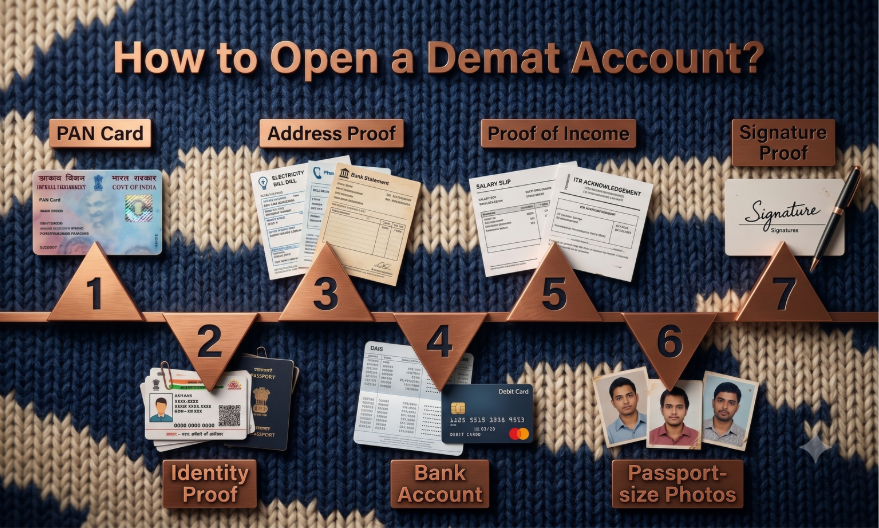
Before you begin the application, keep these documents ready:
Mandatory Documents
1. PAN Card Your Permanent Account Number is the most critical document. Every financial transaction in India is linked to your PAN. Make sure the name on your PAN matches exactly with your other documents.
2. Aadhaar Card Required for eKYC (electronic Know Your Customer) verification. Your Aadhaar must be linked to your mobile number for OTP-based verification.
3. Bank Account Details A cancelled cheque or the first page of your bank passbook showing your account number, IFSC code, and bank branch. This links your bank account to the Demat account for seamless fund transfers.
4. Passport-Size Photograph A recent colour photograph with a white or light background.
Additional Documents (if required)
Income Proof — Required if you want to trade in the Futures & Options (F&O) segment. Acceptable documents include your latest salary slip, ITR, or bank statement for the last 6 months.
Address Proof — If your Aadhaar address is outdated, you may need to submit an alternative address proof such as a utility bill, rent agreement, or passport.
Step-by-Step Process to Open a Demat Account Online
Step 1: Choose Your Broker
Your first decision is selecting the right broker. In India, there are two broad categories:
Discount Brokers — Zerodha, Groww, Upstox, Angel One
- Low brokerage charges (flat ₹20 per order)
- Minimal research and advisory services
- Best for self-directed investors and traders
Full-Service Brokers — ICICI Direct, HDFC Securities, Kotak Securities
- Higher brokerage but offer research reports, advisory, and relationship managers
- Often offer 3-in-1 accounts (Bank + Demat + Trading)
- Best for investors who want guidance
For most beginners, a discount broker is a cost-effective starting point.
Step 2: Visit the Broker’s Website or App
Go to your chosen broker’s official website or download their app. Click on “Open Account” or “Get Started”.
Step 3: Enter Your Mobile Number and PAN
The application begins with your mobile number (OTP verification) and PAN card number. The system pulls basic details linked to your PAN automatically.
Step 4: Complete eKYC Using Aadhaar
This is the most important step. Enter your Aadhaar number and an OTP will be sent to your Aadhaar-linked mobile number. Once verified, your personal details — name, date of birth, and address — are auto-filled from the UIDAI database.
If your mobile number is not linked to Aadhaar, you will need to complete offline KYC by submitting physical documents.
Step 5: Upload Your Documents
Upload clear scanned copies or photos of:
- PAN card (front)
- Aadhaar card (front and back)
- Cancelled cheque or bank passbook
- Passport-size photograph
- Signature on white paper
Tips for uploading documents:
- Ensure all four corners of the document are visible
- The image should be clear and not blurry
- File size should be within the broker’s specified limit (usually 1–2 MB)
- Use PDF or JPG format
Step 6: Fill in Personal and Financial Details
You will be asked to fill in details like:
- Father’s name and mother’s name
- Marital status
- Annual income range
- Trading experience
- Whether you want to activate F&O, commodity, or currency segments
Step 7: Sign Digitally
Most brokers now offer e-signature using Aadhaar OTP or DigiLocker. Some may require a physical signature that you upload as a photo.
Step 8: In-Person Verification (if required)
For certain brokers or if your documents cannot be verified online, an In-Person Verification (IPV) call may be scheduled via video. This is a short 2–3 minute video call where you show your original documents to the camera.
Step 9: Account Activation
Once all details are verified, your Demat and Trading accounts are activated. You will receive your:
- Client ID / DP ID (for Demat account)
- Login credentials (for Trading account)
- UCC (Unique Client Code)
Activation typically happens within 24 to 48 working hours.
Charges Involved in Opening and Maintaining a Demat Account
Understanding the fee structure upfront helps you avoid surprises later.
| Charge | Description | Typical Range |
|---|---|---|
| Account Opening Fee | One-time charge to open the account | ₹0 – ₹500 (many free) |
| Annual Maintenance Charge (AMC) | Yearly charge for account maintenance | ₹300 – ₹700 per year |
| Transaction Charges | Per debit transaction when shares are sold | ₹5 – ₹20 per transaction |
| Pledge/Unpledge Charges | When shares are pledged as margin | ₹30 – ₹50 per request |
| Dematerialisation Charges | Converting physical shares to digital | ₹50 – ₹100 per request |
| Rematerialisation Charges | Converting digital shares back to physical | Rarely used |
| STT (Securities Transaction Tax | Government tax on every trade | 0.025% – 0.1% of trade value |
Important: AMC is charged annually regardless of whether you have traded or not. If you are a passive investor who holds shares long-term, ensure your broker has low AMC charges.
Things to Check Before Opening Your Demat Account
1. AMC waiver offers Many brokers waive AMC for the first year or offer lifetime free Demat accounts under certain conditions. Always check this before signing up.
2. CDSL vs NSDL Both are equally safe and regulated by SEBI. The difference is only in which one your broker uses. CDSL accounts have a 16-digit numeric DP ID, while NSDL accounts begin with “IN”.
3. Segments activated By default, most accounts activate equity and mutual fund segments. If you plan to trade in F&O, commodity, or currency, ensure these are activated at the time of account opening itself.
4. Nominee details Always add a nominee to your Demat account. This ensures your investments are transferred to your family member in case of an unfortunate event.
5. Linked bank account Verify that your bank account is correctly linked by doing a small test transaction after activation.
Offline vs Online Account Opening
| Feature | Online (eKYC) | Offline (Physical) |
|---|---|---|
| Time Required | 15–30 minutes | 3–7 working days |
| Process | Fully digital via Aadhaar OTP | Physical forms + document submission |
| Convenience | Very high | Requires branch visit |
| Documents | Soft copies | Physical originals/attested copies |
| Recommended For | Most investors | Those without Aadhaar-linked mobile |
For the vast majority of investors in 2026, the online route is faster, paperless, and far more convenient.
Common Mistakes to Avoid
1. Mismatched name on documents The name on your PAN, Aadhaar, and bank account must match exactly. Even a minor spelling difference can delay account activation.
2. Submitting blurry or cropped documents Rejected documents slow down the process. Always upload clear, well-lit images with all four corners visible.
3. Not activating the F&O segment at opening If you plan to trade futures and options later, activate this segment during account opening. Adding it later requires additional documentation and processing time.
4. Ignoring AMC charges Many beginners open accounts based on zero brokerage offers but ignore AMC. Over 5 years, a ₹700 annual AMC adds up to ₹3,500 in maintenance costs alone.
5. Opening multiple accounts unnecessarily Having multiple Demat accounts means paying multiple AMCs. Unless you have a specific strategy requiring separate accounts, one is enough.
Frequently Asked Questions
Q1. How long does it take to open a Demat account in India? Opening a Demat account online through eKYC typically takes 15 to 30 minutes. Once your documents are verified, the account is usually activated within 24 to 48 working hours. Some brokers offer instant account activation if your Aadhaar is linked to your mobile number.
Q2. Is it free to open a Demat account in India? Many brokers offer free account opening with zero account opening charges. However, you will still need to pay an Annual Maintenance Charge (AMC) which typically ranges from ₹300 to ₹700 per year depending on the broker and depository participant.
Q3. Can I open a Demat account without Aadhaar? Yes, you can open a Demat account without Aadhaar by submitting physical KYC documents such as PAN card, passport, voter ID or driving licence as identity and address proof. However, Aadhaar-based eKYC is the fastest and most convenient method as it allows fully online account opening within minutes.
Q4. What is AMC in a Demat account? AMC stands for Annual Maintenance Charge. It is a yearly fee charged by your Depository Participant (DP) for maintaining your Demat account. AMC is applicable regardless of whether you hold any securities in your account or not. It typically ranges from ₹300 to ₹700 per year.
Final Thoughts
Opening a Demat account in India has never been easier. With the fully online eKYC process, all you need is your PAN, Aadhaar, a bank account, and 30 minutes of your time. The key is choosing the right broker based on your trading style, understanding the charges involved, and setting up your account correctly from day one.
Once your account is active, the real work begins — learning how to invest wisely. If you are just starting out and want to build a strong foundation in stock market investing and trading, explore our beginner stock market course at Upside. Our expert mentors guide you from the basics all the way to live market strategies.