
Volume Analysis in Trading: Price & Volume Relationship Explained
Introduction
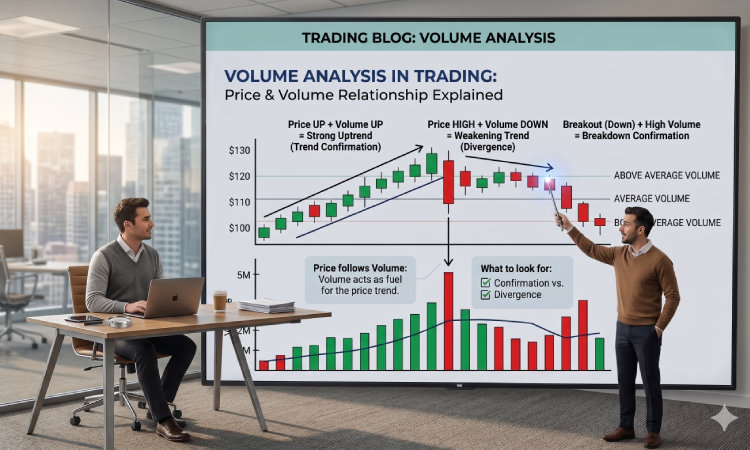
Many traders focus entirely on price movements while ignoring one of the most critical factors: Volume. The price-volume relationship acts as the “truth serum” of the market; it reveals whether a move is backed by real money or is simply a “fakeout.” By learning how to read volume in the stock market, you can confirm breakouts, identify institutional activity, and significantly improve your decision-making.
What is Volume in Trading?
Volume represents the total number of shares traded during a specific period. It is the most objective data point you have—unlike indicators, which are calculated from past prices, volume is a direct count of activity.
- High Volume: Strong participation (Institutional interest).
- Low Volume: Weak participation (Retail uncertainty).
The Core Price-Volume Relationship
Understanding how price and volume move together is essential for any volume trading strategy. Here is your cheat sheet:
| Scenario | Interpretation | Market Health |
| Price Up + Volume Up | Strong Buying Pressure | Healthy Trend |
| Price Up + Volume Down | Lack of Conviction | Weak Trend (Caution) |
| Price Down + Volume Up | Strong Selling Pressure | Aggressive Downtrend |
| Price Down + Volume Down | Lack of Interest | Weak Selling |
Volume Trading Strategies
- Breakout Confirmation: Never trust a breakout if it happens on low volume. A true breakout to new highs should be accompanied by a massive spike in volume, showing that big players are finally “in.”
- Climax Volume: If you see a massive spike in volume after a long rally, it often signals “exhaustion”—meaning the last of the buyers have entered, and a reversal may be near.
- Combining with Price Action: Always use volume to validate your price action entries. A pin-bar candle at a support level is much stronger if it comes with high volume.
Why You Must Learn Volume Analysis
Ignoring volume is a classic way of avoiding common trading failures. It helps you distinguish between a genuine trend and a trap. Whether you are performing intraday trading or swing trading, volume is the most reliable way to gauge “Smart Money” activity.
Master Volume Analysis with Upside Stock Market Institute
At Upside, we teach you to look under the hood of the market. Our curriculum ensures you don’t just see the price, but you understand the “intent” behind it.
- Structured Learning: From fundamental analysis to advanced volume logic.
- Practical Mentorship: Learn to spot institutional footprints in live NSE data.
- Flexible Learning: Visit our share market classes in Mumbai or access our expert-led online modules.
- Complete Roadmap: Our Advance Diploma in Stock Market is designed to turn beginners into disciplined, data-driven traders.
Conclusion
Volume is the heartbeat of the market. When you combine price action with volume, you get a complete picture of market reality. While learning how to read volume takes time, the accuracy it adds to your trading is worth the effort.
Frequently Asked Questions (FAQs)
1. What is the most important rule of volume analysis?
The most important rule is to look for volume confirmation on breakouts and support/resistance tests.
2. Is volume more important than indicators like RSI?
Volume is raw data, while indicators are derived data. Many professional traders consider volume to be more reliable.
3. Does volume analysis work for long-term trading?
Yes, positional traders use volume on weekly charts to identify long-term accumulation or distribution by institutions.
4. Where can I find the best training for volume analysis in Mumbai?
Upside Stock Market Institute offers specialized sessions on price-volume dynamics and institutional strategies.