
Smart Money Concept (SMC) Trading in India – Complete Beginner Guide
Introduction
In recent years, the Smart Money Concept (SMC) in India has gained strong attention among traders who want to move beyond basic strategies and understand how the market actually operates. Instead of relying only on retail methods, many are now shifting towards SMC trading, which focuses on tracking the actions of institutions and large market participants.
However, SMC is not just about fancy terms—it requires proper understanding, structured learning, and consistent practice. In this guide, we will break down how beginners can get started with smart money concept trading effectively to trade alongside the “whales” of the market.
What is the Smart Money Concept (SMC)?
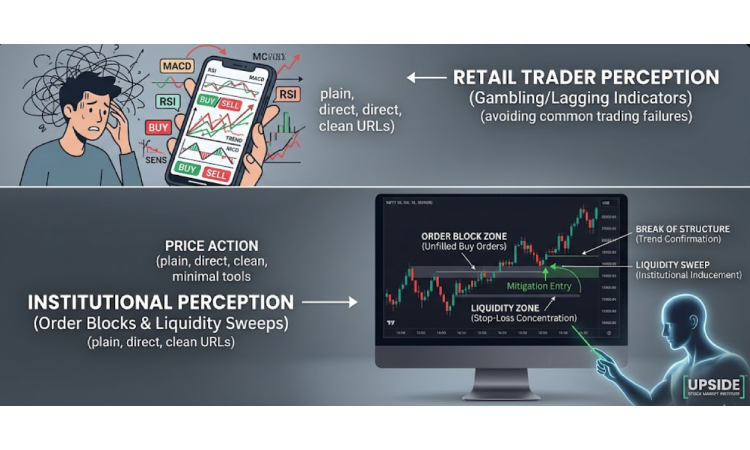
Smart Money Concept (SMC) is a trading approach that focuses on understanding how large market participants—such as institutions, banks, and hedge funds—operate. SMC is based on the idea of following these institutional “footprints” rather than trading like a typical retail trader.
While retail traders often rely on lagging indicators or social media tips, smart money trading focuses on liquidity, market structure, and price behavior to identify high-probability opportunities.
How Smart Money Operates in the Market
Institutions operate with massive capital, meaning they cannot enter the market all at once without moving the price significantly. To execute their positions efficiently, they strategically create liquidity zones.
Often, this involves triggering the stop-losses of retail traders (known as “Stop Hunts”). This process provides the liquidity needed for big banks to enter or exit trades at their desired levels. This is why sudden price spikes or “v-shape” reversals are commonly seen in the Nifty and Bank Nifty.
Key Concepts of SMC Trading
To master SMC, you must understand its foundational pillars:
- Market Structure: Identifying the trend through Higher Highs/Lows or Lower Highs/Lows. A shift here is often called a Change of Character (CHoCH).
- Order Blocks: These are specific zones where institutions have placed large orders. When price returns to these zones, it often reacts strongly.
- Liquidity: Areas where retail stop-losses are concentrated (like equal highs or lows).
- Break of Structure (BOS): Confirms that the current institutional trend is continuing.
SMC vs. Traditional Retail Trading
| Feature | Traditional Trading | SMC Trading |
| Tools | Indicators (RSI, MACD, etc.) | Price Action & Order Blocks |
| Focus | Chart Patterns (Triangles, etc.) | Institutional Liquidity & Supply |
| Accuracy | Often provides lagging signals | Real-time “Leading” analysis |
| Risk/Reward | Moderate | High (Precision entries) |
Moving to SMC is often the best way for traders to start avoiding common trading failures caused by predictable retail patterns.
How Beginners Can Start SMC Trading
- Learn the Basics of Price Action: SMC builds on candlestick formations and support/resistance.
- Understand Market Structure: Master the art of identifying a trend-following strategy.
- Practice Chart Analysis: Look for “unfilled gaps” or “imbalances” on your charts.
- Master One Concept: Focus on Order Blocks first before moving to complex liquidity sweeps.
Learn SMC with Upside Stock Market Institute
SMC is an advanced topic that is difficult to learn from random videos. A structured training program is essential to avoid misinterpreting institutional moves.
At Upside Stock Market Institute, we offer a comprehensive SMC curriculum:
- Institutional Logic: Understand why the market moves, not just how.
- Live Market Execution: Identify real-time order blocks during NSE market hours.
- Expert Mentorship: Get guidance from traders who understand institutional footprints.
- Flexible Learning: Join our share market classes in Mumbai or access our online modules from anywhere.
Whether you are a beginner or looking to upgrade via an Advance Diploma in Stock Market, SMC will give you the edge you need.
Conclusion
Smart Money Concept trading is a shift in mindset. It takes you from being the “liquidity” to being the “trader who follows the liquidity.” While it requires patience and deep practice, the clarity it provides is unmatched. With professional stock market training, you can stop guessing and start trading with the big players.
Frequently Asked Questions (FAQs)
1. Is SMC better than Price Action?
SMC is actually an advanced form of price action. It adds the “Institutional Why” to the patterns you see on the chart.
2. Can I use SMC for intraday trading?
Yes, SMC is highly effective for intraday trading on smaller timeframes (1m, 5m, 15m).
3. Where can I find the best SMC course in Mumbai?
Upside Stock Market Institute offers specialized mentorship in Smart Money Concepts and institutional trading strategies.