
Price Action Trading in India – A Complete Beginner’s Guide
Introduction
Price action trading has gained significant popularity in recent years. Many traders are now shifting towards no-indicator trading, focusing purely on price movements and chart behavior. This approach makes price action trading in India highly practical, particularly for markets like the NSE, where real-time decisions are the difference between profit and loss.
To apply any price action strategy effectively, proper learning and structured practice are essential. In this guide, we will understand what price action trading is and why it is the preferred choice for experienced traders across the country.
What is Price Action Trading?
Price action trading is a method of analyzing the market by focusing directly on price movements rather than relying on lagging indicators. This approach emphasizes understanding chart patterns, price behavior, and market structure, allowing traders to interpret real-time movements more clearly.
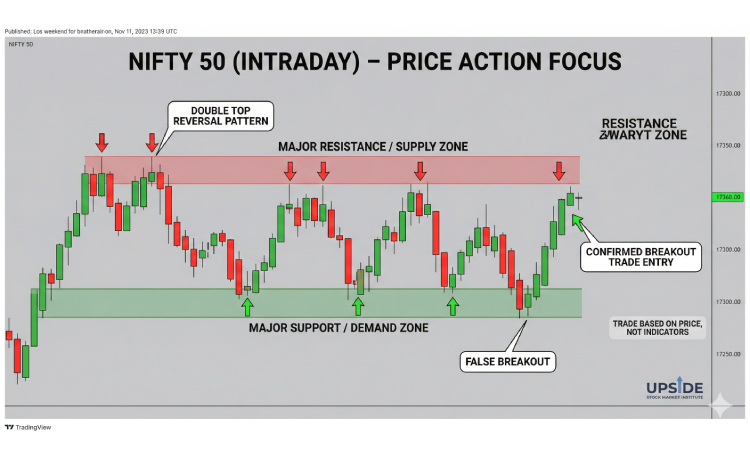
Price action is based on the concept of demand and supply, where price reacts at certain levels due to buying and selling pressure. By mastering candlestick formations, you can learn to read the market’s “footprints” without the need for complex software.
Why Price Action Trading is Popular in India
Price action trading has become widely popular in India due to its simplicity and practical application in real market conditions. It works effectively in the National Stock Exchange of India, where quick decision-making and a clear understanding of how to choose the right stocks are essential.
Its clean method makes it easier for beginners to understand without getting overwhelmed by multiple indicators. Furthermore, professional stock market training often highlights price action because it focuses on real-time behavior, helping traders make more accurate and informed decisions during live market hours.
Key Concepts of Price Action
To effectively use price action trading, you must master the core foundations of market analysis:
- Support and Resistance: These are key price levels where the market tends to react. Support acts as a floor, while resistance acts as a ceiling.
- Trend Analysis: Identifying the direction—uptrend, downtrend, or sideways—is essential for success.
- Price Patterns: Recognizing single candlestick patterns helps traders identify potential entry and exit points.
- Candlestick Behavior: Every candle reflects market sentiment, showing the strength of buyers and sellers through its body and wicks.
Price Action vs. Indicator Trading
Price action and indicator-based trading are two different worlds. Indicators are generally based on past price data and often provide “lagging” signals after the move has already started. This can make charts cluttered and confusing.
In contrast, price action focuses on real-time movement. This allows traders to react more quickly to market changes and keeps charts clean. Moving away from indicators is often the first step in avoiding common trading failures caused by delayed data.
How Beginners Can Start Price Action Trading
Beginners can start by following a disciplined approach:
- Learn the Basics: Understand how price moves, focusing on trends and market orders.
- Practice on Charts: Before risking real money, use historical data to identify patterns.
- Paper Trading: Gain confidence by testing your understanding without financial pressure.
- Focus on One Strategy: Don’t try multiple methods at once; stick to one until you are consistent.
Learn Price Action with Upside Stock Market Institute
For those serious about mastering this art, a structured path is required. At Upside, we focus on a step-by-step journey, moving you from foundational basics to advanced strategies.
Our hands-on market practice allows you to observe price action in real-time. Whether you are looking for share market classes in Mumbai or prefer our Thane branch, we provide the mentorship needed to execute trades with confidence. With both online and offline options, we ensure that every learner gets personalized attention and doubt-solving support.
Conclusion
Price action trading stands out for its simplicity and power. It doesn’t rely on complex tools but on the raw behavior of market participants. While it requires patience and discipline, the rewards of a cleaner, faster trading style are immense. By choosing the right training institute, you can accelerate your learning curve and achieve better long-term performance.
Frequently Asked Questions (FAQs)
1. Is price action trading better than using indicators? Many professionals prefer price action because it provides real-time insights, whereas indicators often lag behind the actual price move.
2. Can I use price action for intraday trading? Yes, it is highly effective for intraday trading. You can learn more in our complete intraday guide.
3. How long does it take to master price action? With consistent practice and structured mentorship, most traders begin to see clarity within 3 to 6 months.