
Understanding Stock Market Orders: Market, Limit, and Stop-Loss Explained Simply
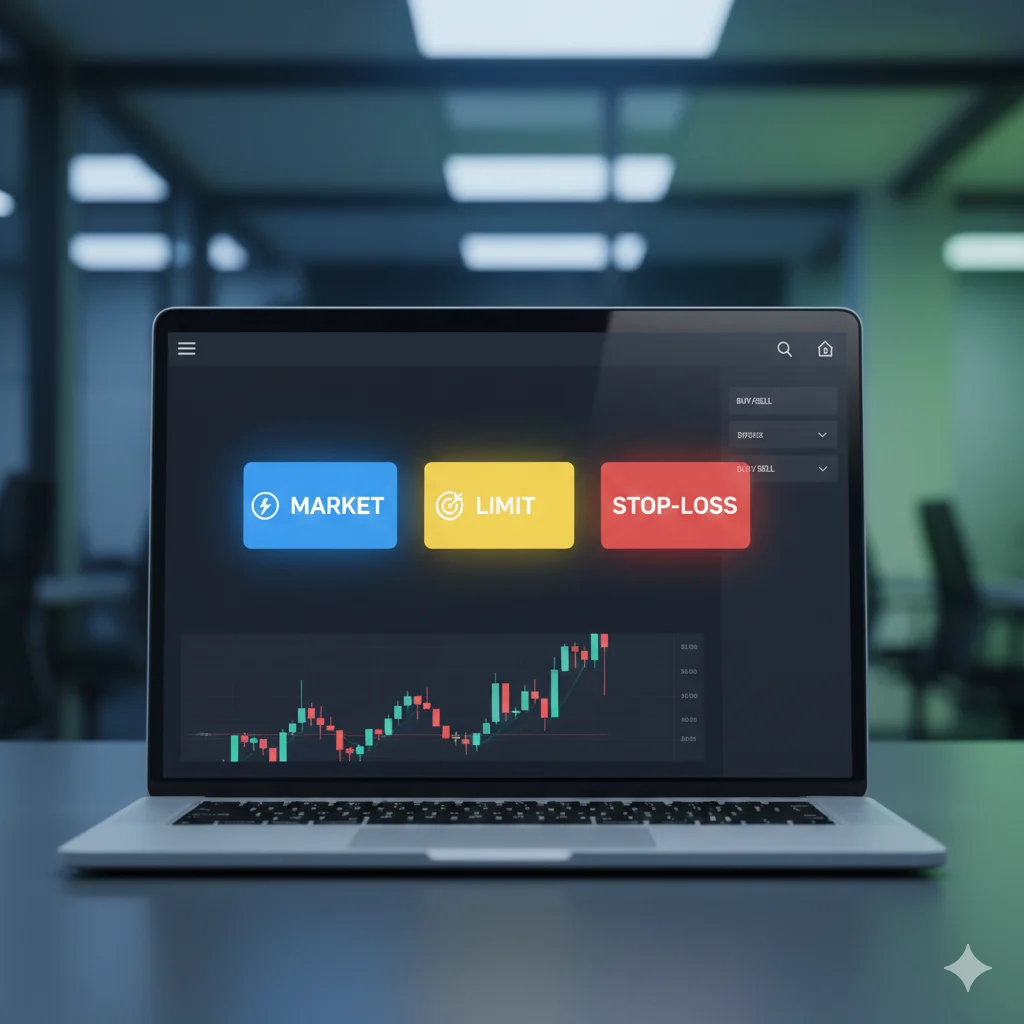
When you place a trade, it’s not just about clicking “Buy” or “Sell.” The type of order you choose determines your entry price, your risk, and ultimately, your profit.
Think of orders as instructions you give to your broker. Whether you want to enter a trade instantly or only when the price reaches a certain level, knowing which order to use is vital. In this guide, we break down the three most important order types every trader must know.
1. Market Order (The Instant Entry)
A Market Order is an instruction to buy or sell a stock immediately at the best available current price.
- Best used for: When you need to enter or exit a trade quickly, such as during high-momentum moves.
- Risk: The price can change slightly between the time you place the order and when it is executed (known as slippage).
- Example: If a stock is trending up and you want in right now, you place a market order, and you get filled at the current price (e.g., ₹100.50).
2. Limit Order (The Price Controller)
A Limit Order allows you to set a specific price at which you are willing to buy or sell.
- Best used for: Low-volatility markets or swing and positional trading where you want a precise entry.
- Risk: If the stock price never reaches your limit, the trade will not execute.
- Example: A stock is at ₹100, but you only want to buy it if it dips to ₹95. You place a limit order at ₹95. Your trade only happens if the price hits that exact mark or lower.
3. Stop-Loss Order (The Safety Net)
A Stop-Loss is the most important tool for risk management. It tells the broker to close your position automatically if the market moves against you.
Two Types of Stop-Loss:
- Stop-Loss Market (SL-M): You set a “Trigger Price.” Once hit, it becomes a market order and sells instantly at the next available price.
- Best for: Guaranteed exit during a crash.
- Stop-Loss Limit (SL-L): You set a “Trigger Price” and a “Limit Price.”
- Example: You buy at ₹70, set a trigger at ₹67, and a limit at ₹65. If the price hits ₹67, the order activates, but it will only sell between ₹67 and ₹65.
- Warning: If the price “gaps down” instantly to ₹60, this order might not execute!
Mastering these orders is a core part of our technical analysis course, where we teach you exactly where to place them on a chart.
Comparison Table: Which Order to Use?
| Basis | Market Order | Limit Order | Stop-Loss Order |
| Execution | Immediate | Only at set price | Only when trigger hits |
| Price Control | None (Current Market) | Full Control | High Control |
| Primary Goal | Speed of Entry | Best Entry Price | Risk Protection |
| Best For | High Liquidity | Patient Entries | Day Trading |
Conclusion
Choosing the right order type is the difference between a professional trader and an amateur. Market orders give you speed, limit orders give you precision, and stop-loss orders give you protection.
If you’re still confused about how to manage these orders in a live market, our advanced diploma in stock market provides hands-on training to help you trade with confidence.